"World Cinema: Israel"

My book, "World Cinema: Israel" (originally published in 1996) is available from Amazon on "Kindle", with an in-depth chapter comparing and analyzing internationally acclaimed Israeli films up to 2010.

Want to see some of the best films of recent years? Just scroll down to "best films" to find listings of my recommendations.

amykronish@gmail.com

Showing posts with label women. Show all posts

Wednesday, July 15, 2026

"Heart of Gold" - a quirky film about a woman struggling with abandonment issues

Heart of Gold לב זהב , directed by Efrat Corem, is a new Israeli feature film which premiered at this week’s Jerusalem Film Festival. 

Mali, is single in her 30s, living alone, working as a ticket inspector on buses in Ashkelon. She is a quirky character, and extremely charming and compelling.  She is a survivor of her own past which has left her particularly vulnerable and we see the scars of that past erupt in her own violence against a couple of disrespectful teens on her bus. Her brother, Shimon, whom she loves dearly, works for the prisons and she is troubled by his having left his wife and kids.  She has a lover, an older man who lives in her apartment building, obviously a bit of a father figure. One day, Mali finds an abandoned baby on one of the buses, and she takes him home.  As she is growing more and more attached to the little baby, her brother and her lover are both trying to convince her to bring him to the police.


When her mother appears on the scene, we realize that this is a story about Mali’s own abandonment by her father, whom she never knew, and by her mother, who left Mali and her brother to make it on their own, about 15 years ago. How can Mali even consider abandoning this child?

Heart of Gold is a wonderful story about a strong, struggling woman, the difficulties and issues in her past and present, and her quirkiness and uniqueness as an adult.  This is a complex film about abandonment, loneliness, working class poverty and family issues in Israeli society.  Highly recommended!


Thursday, August 17, 2023

Prizewinning film, The Future, by Noam Kaplan

 The Future, written and directed by Noam Kaplan, was a prizewinner at the Tribeca Fim Festival, June 2023. 

Noam Kaplan’s previous feature film, Manpower, was about migrant workers living in South Tel Aviv. Check out what I wrote about it on this blog.

His new film, The Future, is a provocative film about women, about the Occupation, and about our future, here in Israel-Palestine.


A Palestinian young woman named Yaffa has been arrested for the assassination of the Minister of Space and Tourism. In fact, in the opening scene, Yaffa (played by a Palestinian actress named Samar Qupty) is brought by a police investigator to re-enact the scene in which she shot and killed the minister.
  Later, the Security Services bring her to the clinic of Nurit (played by Reymonde Amsallem), a futuristic profiler who can supposedly identify potential terrorists and thereby prevent terrorist incidents. Since Nurit didn’t succeed in foretelling Yaffa’s attack on the minister, she is meant to interrogate her in order to better understand what went wrong. 

In her series of meetings with Yaffa, she tries to delve into what kind of relationship she had with her mother, what kind of childhood she had, what motivated her to acquire a gun and to decide to assassinate the minister.  At the same time, she is learning a lot about herself, about her relationship with her own mother and about her desire to have a child.

All of this is told on the background of the entire country waiting to learn of the success of an Israeli spaceship named “The Hope” on its way to the moon. 

Highly critical of the Occupation, The Future offers a shocking look at our future.  Can there be any hope? The film is available from GumFilms.


Saturday, September 24, 2022

Jewish and Palestinian Women Meet in a Video Workshop

Cinema Sabaya, directed by Orit Fouks Rotem, won the Ophir Prize (the top Israeli prize for best film of the year) this past week.  That means that it will be Israel’s entry to the Oscars for Best Foreign Film.  The film is an intimate and sometimes hard-hitting look at the encounters between four Jewish women and four Palestinian women, meeting for the first time in a video workshop in the city of Hadera.  Rona, a young Tel Aviv filmmaker (played by Dana Ivgi), is the workshop facilitator. 

The film takes place in a community center room, where the group of women meet for the video workshop.  Although all of the action takes place in this one venue, and it might seem a bit claustrophobic, many of the scenes are shot by the women themselves, in their own homes.

Rona distributes video cameras, has everyone introduce themselves on camera, and slowly, but surely, the participants get to know one another and their stereotypes about each other begin to change.  Assigned to document their own homes and their own lives, the participants bring into the class raw footage which provides us with an intimate look at the women – their hopes and dreams, and at the same time, their frustrations and issues at home with their husbands and children and pets.

The women represent a microcosm of Israeli life.  Of the four Palestinian women – two wear hijabs (one is retired and one is younger), one is a secular human rights lawyer and the youngest, still lives with her parents.  Of the four Jewish women – one is sort of an older hippie, living on a boat, another is a Russian immigrant, another is twice divorced, and the fourth talks about her husband’s terrible depression.

Multiple issues arise between members of the group and there are some intense moments. For example, one Jewish woman admits to never having really met any Arab women before.  She is accused of not looking, not caring, not seeing.  In response, she accuses the human rights lawyer of defending terrorists.  As the group becomes more cohesive, however, the women begin to share intimate details about their lives, as seen on the video clips that they bring to class, and in the small role-playing scenes that take place.  The younger woman who wears a hijab admits to wanting to obtain a drivers’ license, even though her husband is opposed.  When the Jewish women in the group encourage her to go after it anyway, the older woman with a hijab, tells her (in Arabic) not to listen to them. It is clear that she better understands the dynamic within the Palestinian family, where the man rules the household.

According to the filmmaker, Orit Fouks Rotem, this is a film about women and women’s stories: “I think that the film offers a rare glimpse to the hidden depths of the lives of Jewish and Palestinian women, where their central point of convergence, the most profound thing they had in common, is simply being a woman. This turned to be stronger than their religion or cultural world. I hope the film will offer an intimate and empowering conversation, not ignoring the different backgrounds, but rather proving that this does not provide an obstacle in creating deep connections and true friendships. Women who want their stories to be heard, but are scared, or are unable, to tell them in the first person. Therefore, this is a film that also deals with the power of cinema.

Cinema Sabaya is a film filled with surprisingly intimate and tense moments.  The team of nine women are all played by strong actresses.  Moreover, the film goes beyond stereotypes, providing the viewer with a glimpse into the complex lives of those participating in the video workshop. 

The film is also a statement about the possibilities of Arab-Jewish coexistence in Israel. Through genuine dialogue—which was engendered by the making of very personal films in which each woman shared her dreams—it becomes apparent that Jews and Arabs can actually learn to live together in Israeli society, contrary to the conventional wisdom which fosters only perpetual suspicion and conflict.

Cinema Sabaya is available from Memento International.


Sunday, July 31, 2022

A New Israeli Film about Sexual Abuse

All I Can Do, directed by Shiri Nevo Fridental, is a new feature film which was screened this past week at the Jerusalem Film Festival.  It is about sisterhood, about the #MeToo movement, about women’s stories of sexual abuse, and about one woman working to try to make a difference.

The story is about a man accused of sexually abusing a 12-year-old girl, who was babysitting for his children.  Re’ut is a prosecutor in the Israeli justice system, who gets handed the new case. Now, more than 10 years after the events, the plaintiff, Efrat, has decided to come forward.  She is not your most normative young woman – sporting tatooes, spouting some foul language, and obviously emotionally damaged by the abuse that she experienced as an adolescent.  Despite her hardened exterior, she is quite fragile -- suicidal, vulnerable, and needy.  It’s hard to prosecute a case with no evidence, and only one plaintiff. But Re’ut is committed to getting justice for Efrat, no matter what it costs her professionally and emotionally.  

It turns out that Re'ut also has a story of abuse in her family.  She comes from a family of Russian immigrant women.  She was brought to Israel at the age of 7 by her mother and her grandmother and she has a special relationship with her grandmother.  But her mother, who herself suffered abuse from the hands of her husband back in Russia, is somewhat temperamental and they don’t have the best relationship. 

These are women’s stories.


Wednesday, August 1, 2018

Sexual Harassment in the Workplace


Working Woman by veteran filmmaker, Michal Aviad, is a strong statement about sexual harassment in the workplace. 

Orna is married to Ofer -- they have a wonderful relationship and share in taking care of their three children.  Recently they opened a restaurant and are financially stressed, so Orna finds a job working for Benny, a builder putting up an up-scale apartment tower in Rishon LeTzion with attractive views of the sea.  She starts out as his personal assistant and eventually moves up to director of sales.  But something is wrong in their relationship and the sexual tension is thick and unmistakable. Benny starts out by making comments about her hair and suggestions about how she dresses – and things move on from there.

At a time when #MeToo has become so relevant in every woman’s life, along comes a film about sexual harassment in the workplace, making it extremely up-to-date and relevant.  What woman has not experienced some harassment in her professional life?  Why can’t we be looked upon as professional women instead of sexual objects?  Why have we been afraid to speak out at times of harassment?  Why are we so often blamed for what is obviously terribly inappropriate behavior on the part of the boss?
 
Working Woman is an extremely effective film, portraying compelling and complex characters, with superb cinematography – all leading the viewer to become an unwitting witness in a realistic and hard-hitting narrative.

During the film, I asked myself why didn’t Orna tell her husband about the increasing harassment at work?  Was she worried about how he would react?  Was she afraid of losing her job?  Or was she unsure of her own role in what was taking place? Why doesn’t she take revenge?  As things become more and more unbearable, Orna realizes that she must take steps to preserve her own self-image and dignity.

The film was produced by Lama Productions and United King Films.

Wednesday, January 31, 2018

Shelter by award-winning director Eran Riklis

Shelter (מסתור) is a thriller by Eran Riklis, one of Israel’s greatest filmmakers, known for his many prize-winning films including Syrian Bride, The Lemon Tree, Cup Final, The Human Resources Manager, and Dancing Arabs. 

As in The Lemon Tree, here, in Shelter, he tackles the subject of relationships between women across the divide, showing the compassion and humanity of the “other.”  But the films are so different!

In this film, Nomi is sent on a mission by the Mossad to babysit Mona, a Lebanese informer, hidden in Germany, having just undergone extensive plastic surgery in preparation for her promised new life in Canada.  It seems like a simple mission, but nothing is simple when the Mossad is involved.
 
An adaption of Shulamit Hareven’s story The Link, the film combines two genres. One is a psychological study of two women and how the relationship between them intensifies as they are confined to an apartment in Hamburg. Their personal stories are told through flashbacks as they confide in each other.  Nomi has spent the last two years stricken with grief as she has been mourning her husband who was killed by a bullet meant for her. Now, she wants to have the baby that she never had when her husband was alive.  Mona, previously the lover of the head of Hezbollah in Lebanon, is feeling cooped up, fearful for her own personal well-being and her future, and crazy with worry about her 8-year-old son who is hidden in a monastery in Lebanon. Both women are struggling with issues of identity, hiding who they are, trying on wigs, wondering who and where they will be when all of this is over.

The film is also a thriller about international espionage and intrigue.  Tension mounts as Nomi realizes that she is being watched, as the Hezbollah are searching for Mona who has betrayed them, and as the Germans and the Americans are hoping to use Mona as a pawn in their game of buying favors with Iran against Hezbollah.

I enjoy thrillers, but I don’t usually find them so compelling! This film is a particularly captivating and powerful story about two women, their fears and their worries, wonderfully performed and well-crafted, filled with tension and twists and turns.  It seems that betrayal is the name of the game.  And loyalty brings redemption.

Shelter is available from Menemsha Films.

Monday, June 19, 2017

So-called Honor Killings

Here in Israel, the subject of so-called “honor” killings has been in the news a lot lately.  It seems that a surprisingly large number of Palestinian women have been murdered and all-too-often their murderers have not been apprehended.  Just this week, the headlines have been filled with the story of a 19-year-old woman who was murdered by her uncle in the northern Negev.  Both the Israeli and Palestinian Authority police have been trying to deal with this phenomenon but have not had much success.  In fact, the numbers of young women falling prey to this type of tragic end has risen in recent years. 

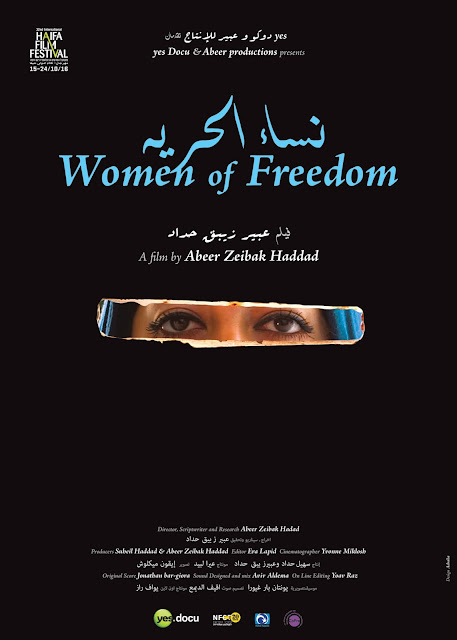
With her new film, Women of Freedom, Abeer Zeibak Haddad (who previously made Doma, about sexual abuse within the Palestinian community, which was reviewed on this blog in 2012) has created a hard-hitting documentary look at some of the issues and emotional personal stories of these honor killings. 


The film opens with a letter from a prisoner, a man who murdered his sister 17 years ago when he was 20 years-old.  Now, he realizes that he murdered her not for what she did or didn’t do but out of his own “despair, weakness and ignorance.” 

This film is filled with heart-breaking stories of young women and their families. The women are attacked for diverse reasons -- for wanting to break off with an abusive fiancé, for contemplating marriage with a non-Muslim, or for allegedly having sexual relations out of wedlock.  Members of the family feel that they must deal with these transgressions – no matter how insignificant – with their own hands. 

We meet the parents of Alaa, from Haifa, who studied to be a dentist.  They are compulsively caring for her gravesite. In another family, Rim went to the police to report that she felt threatened by her four brothers.  The police sent her home and she was murdered a few hours later. 

We also meet some women who have survived attacks by members of their families.  Halaa was attacked by her own knife-wielding father, but her aunt succeeded in stopping him. She explains that if you do something that seemingly only affects your own life, all of your extended family looks at it as something that also affects them. In fact, it reflects on them.  “If I make a mistake, everyone will get hurt.” In another example, Amal was purposefully hit by a car.  She was battered and bleeding but she survived.  She asks, why doesn’t our society defend its women?  She says her brother has destroyed her life and her dreams and she refers to herself as an “unburied corpse.”
 
This is a particularly artistic and human film, but Haddad has decided to also include statistics:  58% of Palestinians think that if a woman is murdered, it’s her own fault; 55% support the “honor” killings; 51% believe that the killers should not be brought to justice.  Haddad herself is haunted by a gruesome story from 40 years ago of a young woman whose grandmother crept into her bedroom at night and poured mercury into her ear.   She died shortly thereafter.

In my opinion, the name “honor killings” is a misnomer for two reasons.  First of all, how can it ever be a matter of honor to murder a young woman?  Secondly, it is important to note that not all of these women have been killed for allegedly bringing shame to their families.  Some of them were killed for other reasons, but the Israeli Arab community is suspicious that the Israeli police has been classifying the murders as honor killings as an easy way for them to ignore murders within the Arab community.

An extraordinary film, Women of Freedom (documentary, 57 minutes) provides a sensitive and substantive look at a terrible phenomenon that is continuing, without any seeming end in sight. The film is available from Journey Productions at www.journeyman.tv or contact the filmmaker Abeer Zeibak Haddad at suheilh@zahav.net.il.

Wednesday, April 26, 2017

Faith, Intermarriage, and Acceptance of the "Other"

Between Worlds (בין העולמות), directed by Miya Hatav, is a feature film about faith in God and acceptance of the “other”. The story tells of a relationship between two women who are from different worlds –one is an ultra-orthodox Jew and the other is Arab.  They meet in a hospital, both visiting the same young man who has been hurt in a terrorist incident.  One woman is his religious mother and the other is his girlfriend.  When his father arrives, it becomes clear that there has been a deep family rift for a long time. 

The girlfriend, Amal, is Arab and is afraid to tell the family who she is.  Pretending to be visiting someone in a nearby room, she slowly forms a relationship with the mother.  While they are at the hospital all day, the father, a sofer, is searching for an explanation for what has happened to his son and busies himself with checking Yoel’s tefillin.  Meanwhile, the mother realizes who the girl really is and a touching and warm relationship begins to develop between them.

Telling a woman’s story, this film is both a surprisingly human portrayal and also a tragic story.  It is human because we feel the loneliness, the tension and the fear as both women try to resolve their feelings about the young man in the hospital bed.  It is tragic because both women are trapped in their worlds, unable to truly reach out to the other.  Without offering a spoiler, I must say that the film’s ending is a bit disappointing, not really resolving any of the issues that arise within the narrative. 


Between Worlds (feature film, 84 minutes) is available from Go2Films.  

Thursday, January 19, 2017

Palestinian Israeli Women living in Tel Aviv

In Between (Bar Bahar), the debut film by Maysaloun Hamoud, is a compelling story about three Palestinian Israeli women, who are caught between their traditional society and the allure of the independent and open lifestyle of Tel Aviv.

Layla is a sophisticated lawyer.  She dresses beautifully and enjoys smoking, drinking, drugs and partying.  When she finally meets the man of her dreams, a handsome Arab filmmaker, it becomes obvious that he is not willing to bring her home to meet his parents unless she dresses like a traditional Muslim.  But Leila is not willing to change who she is and how she behaves for anyone.

Salma works as a barman in Tel Aviv, and comes from a conservative Christian family.   She and Layla host some of the best parties!  Salma’s parents are trying to find a suitable mate for her and are aghast to discover that their daughter is living a non-normative lifestyle. 

Nur is the most traditional of the three, wearing a hijab, and engaged to marry a religious man.  But she is disappointed to discover that he wants his wife to be a stay-at-home mom, even though Nur is completing her degree in computer science at Tel Aviv University.

These three women, although very dissimilar, are facing similar dilemmas about moving from the traditional requirements of life in the village to a more modern life in the city.  One of the highlights of the film is the way that the filmmaker makes these three apartment-mates work together in common cause, even though they are so different from each other.  They are all looking for a suitable partner and they are fluent in Hebrew and would almost pass in Israeli society except for the fact that they are proud Arabic speakers and never hide it.  In one humorous scene, a shopkeeper makes a face when she hears them speaking Arabic.  One of the girls says, don’t worry, we don’t bite! 

The filmmaker has chosen to portray men in this film in a very critical light.  The most compelling male figure turns out to be Nur’s very traditional father, who is loving and understanding of his daughter in the time of a crisis.  But, as part of the filmmaker’s criticism of the Arab patriarchal society, the other male characters are stereotypes of Arab men.  In fact, in a recent column in Ha’Aretz, Sayed Kashua wrote about how people from the Muslim city of Um el-Fahm are critical of the film. He explains that this is because one of the major male characters is a religious Muslim man from Um el-Fahm who turns out to be a chauvinist and a rapist.

In Between includes a lot of wit and charm.  Variety called it Sex and the City for Palestinian Israeli women living in Tel Aviv.  Although there is an extreme amount of smoking, drinking and drugs, I found it enormously enjoyable mainly because it provides a window into the problems of women trying to move from a traditional family life to a more independent one.


Wednesday, October 19, 2016

Sand Storm by Elite Zexer

The new Israeli feature film that everyone is talking about is Sand Storm (Sufat Hol), directed by Elite Zexer.  This film is about those Bedouin who live in small villages, many unrecognized, dotting the hills of the northern Negev.  Some live in shacks, and some live in small homes, all without basic infrastructure provided by the government.  Those who can afford it have generators which provide electricity for basic needs such as small refrigerators and washing machines.  This is a patriarchal and traditional society. 

The film tells the story of a mother and daughter in one family within this closed society.  Layla, the oldest daughter, is attending a nearby college.  Her father obviously indulges her and, in the opening scene of the film, he is teaching her how to drive.  She is independent, bright, and in love with a lovely Bedouin young man from another tribe, whom she met at school. They want to marry.  


Her mother, Jalila, on the other hand, is suffering humiliation and unhappiness as she prepares the wedding feast for her husband who is taking a second wife.  The story of these two women, mother and daughter, provides the basic narrative structure for this film.

The dancing at the wedding celebration shows Jalila celebrating with a forced smile.  Because there are no men at this celebration, she is wearing a false mustache, creating a striking image.  But her face also shows a mix of pain, determination, and mostly worry about her daughter who she knows will never be permitted to marry the man she loves, a man from outside the tribe.
 
The characters in the film are compelling, even the father whose actions, in dealing with these two strong women in his life, are based on what seems to be at first unclear motivations.  It eventually becomes clear to the viewer that he is mostly conforming to what is expected of him and makes all of his decisions based on what other men in their world would say.   

This is a gritty and authentic picture of life for the women, a hard-hitting emotional and psychological study.  These women live very difficult lives and they desperately need to believe that things might change for them and that their family conditions might improve.  You might think that the position of the new second wife is actually to be envied.  But the viewer gets a glimpse at her own humiliation at not having been able to catch a young husband who would make her his first wife.
 
Sand Storm was a prizewinner at the Sundance festival, and more recently, the winner of multiple Israeli Ophir awards, including best directing and best film, which makes this film the Israeli entry for the Academy Awards.  Debut filmmaker Elite Zexer was originally drawn to the world of the Bedouin of the Negev via her mother who is a photographer and had long ago made personal connections with this community.  Zexer is to be commended for her success as a Jewish filmmaker looking in at Arab society.  This film is a tour-de-force in its emotional power, effective script and visual strength.
 

Sunday, October 16, 2016

Child Brides

Child Mother, directed by Yael Kipper and Ronen Zaretzky, is a compelling documentary film made in a minimalist style, which tells an extraordinary story.  This is a film about Israeli women, today in their 80s, who were married off at very young ages.

Esther, born in Morocco, 84-years-old, sits in her apartment in Jerusalem, telling her story to her daughter Sima.  She was 12-years-old when her father married her off.  At first, she thought it would be fun – new clothes and a big celebration.  But when she realized what her new husband wanted from her, she ran away.  When he found her, he took her by force.  

Naomi was born in Yemen.  Hana was born in Morocco.  Ziona, from Yemen, had 12 children and lost her first child in childbirth. 


These women talk of loveless marriages, of painful memories, of multiple miscarriages, of husbands who were 40 years older.  When they came to Israel, their husbands were already older men and, as a result, the women had to work hard to support the family.  One woman cleaned houses, away from home for days at a time.  Another worked planting trees for the JNF.

These are painful stories of tragic childhoods, of motherhood at young ages, of little girls forced to live with cruel mothers-in-law, of living in fear of their husbands.  In many cases, these are stories that were never told – mothers keeping their stories secret from their children out of shame and a deep-seated need to forget. 

One grown daughter, now 60-years-old, begs her mother for a hug and a kiss.  But her mother tells her that she was never hugged or kissed as a child and as a result does not like to be touched.  Through tears, they are finally able to cling to each other. 

Child Mother was the winner of a Special Jury Mention at the Doc Aviv film festival.  According to the jury:  "The film Child Mother delicately reveals the harsh story of women who, as young girls, were given to much older men and enslaved by them, in the name of tradition. The filmmakers succeed in portraying a complex, complicated and important story – through multiple layers of concealment, denial and shame. A story that echoes and has existed from ancient times to our own days."

Child Mother (documentary, 89 minutes), is available from Michael Treves JMT Films.
Watch the trailer! 

Saturday, September 24, 2016

Religious Fanaticism


The Women’s Balcony is a debut film by Emil Ben Shimon, about the dangers of religious fanaticism.  This is a charming and joyous story of a small Sephardi synagogue in Jerusalem, where the women are an integral part of the religious community.  This is a tolerant community, led by a wise and understanding rabbi, who offers a moderate brand of orthodoxy.  One Shabbat morning during a bar mitzvah, the women’s balcony collapses.  When the dust clears, it becomes apparent that the rebbetzin has been badly hurt and, as a result, the rabbi falls into a state of confusion and despair.  The community becomes paralyzed at the prospect of rebuilding their synagogue, especially without the leadership of their beloved rabbi. 
  
Along comes a charismatic, young rabbi who steps in and offers to takes charge.  He immediately sets his hand to getting permits and renovating the synagogue.  His renovation, however, does not include the rebuilding of the women’s balcony.  He also makes additional changes -- he convinces the men that their wives must be modestly dressed and must cover their heads.  This causes a rift among the women – some accept this and others refuse to.

The women decide to take matters into their own hands and they begin a fundraising campaign to rebuild their balcony inside the synagogue. They are a strong part of the community and the new rabbi’s mistake is that he tries to brush their needs aside.

The film includes wonderful characters – both the men and the women.  There is the owner of a spice shop in the souk and his smart and loving wife.  Then there is the younger generation – a woman involved in a budding romance with one of the charismatic rabbi’s yeshiva students, who himself begins to realize that his rabbi is willing to compromise his ethical standards, all for the advancement of halacha (Jewish law).   


The Women’s Balcony is a fast-paced film, full of quirky characters, lots of good food, all set on the backdrop of the winding alleyways of the old neighborhoods of Jewish Jerusalem -- a film about the empowerment of women and about fighting back against religious extremism.  The film is available from United King.

Thursday, September 15, 2016

Disappointing

Moon in the 12th House, directed by Dorit Hakim, is a nice story about two sisters in contemporary Israel.  We see in the opening shot that, years ago, they experienced a family trauma, and as a result, Mira, the older sister, left home.  Leni was left behind, living in their rural childhood home with their father, who, now years later, can no longer care for himself. 

Now, Mira works at a club in Tel Aviv and is in an abusive relationship with the club owner.  When she discovers that she is pregnant, and doesn’t want to have an abortion, she goes home to her sister.  It’s not easy for the two sisters to rebuild their relationship (although this is not handled with enough depth), to rekindle what they had as sisters, and to open up to each other. 

Meanwhile, Leni is having a fling with the 16-year-old boy next door on the moshav, and we see repeated scenes of her swimming, obviously a metaphor for her seeking freedom from the family commitments that bind her.   

This is a family story of reconciliation, as we discover what happened that tore apart the family years ago.   The title is a reference to Mira's interest in horoscopes.  I just wish the reconciliation had better tension and script development. 


Wednesday, July 27, 2016

The Role of the Ultra-Orthodox Woman

In a new documentary film, Measures of Merit, by Irit Dekel and Roni Aboulafia, we are offered a view of the world of Haredi (ultra-orthodox) women.  It is not easy being a Haredi woman.  They live in a man's world -- their lives are run by their husbands and their rabbis, they are harassed by the dayanim (judges) in the religious courts, and they have no representation in the Knesset.

This film offers a fascinating portrayal of one woman, Ruth Colian -- a woman who wants to change all that. She is a courageous and outspoken Haredi woman who is fighting for representation for Haredi women in the Knesset.


It would be a dramatic precedent for her to obtain a place in the Knesset.  The official Haredi point-of-view is that women have different roles in life from men.  Women must take care of the children, the home, and obey their husbands and their rabbis.  Otherwise, they begin to descend the dangerous slope towards assimilation.

But Ruth Colian believes that women's voices must be heard and that issues relevant specifically to women -- such as poverty, divorce, and gender issues -- are not being given fair treatment by the Haredi men who have been elected, who do not see themselves as representatives of women also.  In this film, we see Colian decide to create her own political party and to run for the Knesset, and we realize that this is not because she has a strong ego but rather she is motivated by a responsibility for the quality of her daughters' future.

In one of her speeches, she opens with: "It's more worthwhile to be silent, but more honorable to fight."

There are those who argue that it is immodest for a woman to be active in the political sphere and that her party contradicts the values of Haredi life.  But she cannot be dissuaded.

This is a film filled with drama and tension as election day approaches and our candidate works tirelessly, with virtually no budget, to get elected.

Measures of Merit (Hebrew title: A Jewish Woman, 49 minutes, documentary) is available from Ruth Diskin Films.

Sunday, April 17, 2016

A Portrait of a Cultural Hero


Safaa Dabour is a cultural hero within the Arab community in Nazareth.  For decades, the Israeli Arab community did not have movie theaters and cultural centers, then along came Safaa Dabour who established the first cinematheque to serve that community.  She is a strong and independent woman, the mother of two grown sons, a religious Muslim woman, a widow. The award-winning documentary portrait, Nazareth Cinema Lady, directed by Nurit Jacobs-Yinon, masterfully tells her story -- integrating the personal with the story of the Nazareth Cinematheque, which she established in 2003. 


Dabour talks about how people laughed at her when she said she wanted to establish the first movie theater to screen Arab films for Arab citizens.  She desperately wanted her children to be proud of her, but it's a complicated and frustrating business for a woman in the international world of film.  Sensitively produced and dramatically portrayed, we see her story take shape, as she talks about her difficulties with distributors, how she travels to Amman to collect films, her stormy relationship with her sons, and her traumatic attempt to expose corruption. There are battles that she wins, succeeding in screening films to fully sold-out audiences -- and battles that she loses, such as her fight with the franchise restaurant owner who insists on serving alcohol in the building of the cinematheque. 

This is a portrait of a charming, yet somewhat stubborn and immensely courageous, woman who sets her sights on fulfilling her vision for the Arab community of Nazareth.  
  
Nazareth Cinema Lady (documentary, 52 minutes) is available from JMT Films.

Sunday, November 22, 2015

The Female Perspective


Women in Sink (aka The Shampoo Summit) is a documentary film about women in Haifa.  In a particularly creative move, filmmaker Iris Zaki takes her camera and connects it to a metal pipe in front of the women as they are having their hair shampooed in a salon.   

The filmmaker has chosen a fascinating way to get women talking -- by catching them at Fifi's Salon in an Arab neighborhood in Haifa. Here, the women talk about love, politics, children, and more.   The result is an insightful and honest short documentary film about contemporary Israeli society.  
 
The multi-ethnic clientele tell wonderful stories, as Iris washes their hair and interviews them in this particularly intimate and vulnerable female setting.  One woman talks about her mother who was born and brought up Jewish and married her father, a Christian Arab.  Some of her siblings consider themselves Jewish but she is a believing Christian.  The hair stylist is a Christian Arab woman and she feels that she belongs here.  In fact, her daughter served in the army and matured a lot as a result of that experience.  Another woman talks about the deterioration in relations between Christians and Muslims today, especially in Nazareth.  Another talks about the empathy and sensitivity of women.  If only political matters were in the hands of women, then things might be different!

Iris Zaki plays multiple roles in this film -- film director, producer, investigative reporter and shampoo assistant.  She concludes that there is something special in the friendship and acceptance between women and she says it gives her hope. 

Women in Sink was the winner of two big awards -- best short doc at Haifa Film Festival last month and special jury award at Karlovy Vary. The film ( documentary) is available from Go2Films
A shorter version, The Shampoo Summit, is also available.

Monday, June 29, 2015

Encouraging Understanding Between Women


I recently received publicity on a small film festival called Nashim Nehedarot which is taking place in different venues in Israel.  The festival offers films that will help to bridge the divide between ultra-orthodox and secular women in Israel.   

One of the films being featured is Barren, עקרה , a short drama by Esti Shushan.  This is a compelling portrayal of an ultra-orthodox, young woman.  Nomi is married just a few years, but her husband is terribly disappointed that they haven't been able to get pregnant.  After having already raised children as the big sister to five younger siblings, however, Nomi is ambivalent about having children.  Short and to the point, extremely well-made and touching, this film provides a different perspective on ultra-orthodox women.  

This film was produced with monies from the Gesher Multi-Cultural Film Fund.  I sit on their Board and they provide me with the possibility of previewing so many of the latest Israeli films.  Many thanks to Ziv Naveh and the staff!