"World Cinema: Israel"

My book, "World Cinema: Israel" (originally published in 1996) is available from Amazon on "Kindle", with an in-depth chapter comparing and analyzing internationally acclaimed Israeli films up to 2010.

Want to see some of the best films of recent years? Just scroll down to "best films" to find listings of my recommendations.

amykronish@gmail.com

Showing posts with label Palestinians of the West Bank and Gaza. Show all posts

Wednesday, July 23, 2025

The Sea - a Palestinian and Jewish collaboration

The Sea, directed by Shai Carmeli Pollack, is a film about the Occupation, about the walls that we put up between us, and about how they impact the simple dreams of a child.  The film was produced as a collaboration, between a Jewish director and a Palestinian producer. 

Khaled lives in a village in the West Bank, not far from Ramallah.  At the end of the school year, his class is going on a bus trip to the Mediterranean Sea.  All of the children are excited for this, since going to the beach is not a usual event for them.  On the way, they have to pass through a checkpoint in order to enter Israel. 

Khaled’s name does not appear on the list of those approved to pass through the checkpoint and he is sent back to the village.  Extremely disappointed, he decides to set out on his own. He wakes up in the middle of the night and sneaks out of the house to smuggle himself into Israel.  He experiences many encounters with Jews and Arabs alike who help him along the way. 

Worried about his son, his father, who works without a permit inside Israel, leaves the construction site where he is working, to go find his son, even though the risks of being caught without a permit are troubling. Both father and son encounter some wonderful people along the way.

Some films about the Occupation are hard-hitting, filled with violence and difficult to endure.  This one is different. It provides beautiful insight into a family, especially the life of a 12-year-old boy, and how difficult life can be for Palestinians living in the West Bank. I especially liked the character of Khaled’s grandmother, who has taken upon herself the difficult task of raising the four children since Khaled’s mother died of cancer two years earlier and the father is working to support them at a job inside Israel.

At the Jerusalem Film Festival premiere screening, which was filled with family and friends of the cast and crew, about half Palestinian and half Jewish, the film director said poignantly: “The making of this film, Arabs and Jews working together on the set, gives me a lot of hope.”  It is good to have some hope in these difficult days in Israel!

The Sea (93 minutes) provides a wonderful story. The film is available from the producer at Majdal Films, baheir@gmail.com

Shai Carmeli-Pollack also made Bil'in My Love (2006), one of the best documentaries about Israeli activists helping in the fight against the placement of the Separation Wall separating Palestinians from their lands. I never forgot one hard-hitting line from that film.  Standing on a hilltop at Bil'in in the West Bank, looking out at the horizon where you can catch a glimpse of Tel Aviv in the distance, someone says, You can see Tel Aviv from Bil'in, but you don't see Bil'in from Tel Aviv.  Wow. That was so true.  No one see or cares. 


Thursday, June 19, 2025

Trust No One - a new Israeli TV series on Netflix

 A new Israeli TV series has become available on Netflix this past week.  Trust No One (הראש) is a suspenseful spy thriller about the functioning of Israel’s General Security Services agency, better known as the Shin Bet.  The series was created by Ron Leshem, Amit Cohen, Daniel Amsel and directed by Ofir Lobel and was produced for Keshet (one of the major Israeli television networks) by Shenhar Productions.

The series focuses on a fictional head of the Shin Bet, Itamar Molcho (played by Yehuda Levi), his family, his elite team of top-level associates whom he trusts with his life, and the operatives/assets/informants that they run in Gaza.  When someone dumps files on the internet about their operatives (in Wiki-leaks style), everyone must rush to first, save the lives of the operatives who have now been exposed, and second, search out the mole who has been leaking their top-secret information to the internet.  Add to this lots of illegal shenanigans, lots of sexual tension, and complications that keep leaving the viewer wanting more. Needless to say, everyone has secrets to hide, and you cannot keep up with the array of suspects!


The main storyline centers around Shuruk, the daughter of a Hamas Sheikh in Gaza, who is a Shin Ben operative. We recognize here that this is based on a true story from the 1990s -- the son of a founder of Hamas, Moab Hassan Yousef, became a spy for the Shin Bet in a high profile story. Another part of the story that is based on real life -- the Head of the Shin Bet is having his reputation and career questioned by the Prime Minister. We are all mindful that there has been a current controversy between the Head of the Shin Bet and the Prime Minister of Israel, which makes this series highly relevant.

I loved this series, but there is a major element which I found troublesome. The series  was produced before October 7th, but it is all about information gathering in the Gaza Strip. If the drones, cameras, and cyber specialists at the Shin Bet, as portrayed in this dramatic series, provide Israel with so much knowledge of what is going on in Gaza on a regular basis, then how did the October 7th disaster occur without serious intelligence warnings?

Nevertheless, Trust No One is a great series, a thriller with lots of twists and turns. So well-made and highly recommended!

Trust No One (TV series, 9 episodes, 2025) is currently streaming on Keshet or on Netflix.


Saturday, May 10, 2025

No Other Land - Academy Award winner for best feature-length documentary

Although No Other Land won the Academy Award for best documentary feature-length film, it is almost impossible to view it in Israel.  I took advantage of the fact that I was visiting in New York and went to the Film Forum on W. Houston St. to see the film last week.

No Other Land (documentary, 2024, 95 minutes) was directed by two Palestinian filmmakers: Basel Adra and Hamdan Ballal, and two Jewish Israeli filmmakers: Yuval Avraham and Rachel Szor. This is a hard-hitting award-winning film about the oppressive and cruel nature of the Israeli occupation of the West Bank.  The story takes place in Masafer Yatta, an area of 20 hamlets spread around the South Hebron Hills in the West Bank, not far from the Jewish settlement of Sussiya.

The film opens with Basel, one of the film directors, a Palestinian activist in his mid-20s, remembering back to when he was about 5-years-old and his father, Nasser, also an activist, was arrested for the first time.  Basel’s father owns a gas station, which is really just one gas pump, and he supports his family from the cars that stop by and fill up. 

They are battling the Israeli military for rights to stay on their land, where they have lived for more than one hundred years.  The Israeli army has decided to prevent the Palestinians of the area from living here, claiming that they need this area for an active military training zone, and they are enforcing a systematic destruction of entire villages.  Periodically, enormous bulldozers arrive to destroy homes. Imagine the trauma for the children standing by watching as their homes are demolished. These people are not primitive cave-dwellers, but after a village is destroyed, we see that the families have no other choice but to retreat and set up home in nearby caves.

Yuval is an Israeli journalist who grew up in Beersheba. He comes to cover the story, becomes emotionally involved in what’s happening and builds a strong attachment to the place, the people, and a real friendship with Basel.

The major part of the film tells the story of Basel’s activism, rooted in his father’s activism, how he uses social media, organizes protests, and tries so hard to protect their homes and villages.

Because the Palestinians persevere and continually rebuild, the military comes to confiscate their tools and their generator.  A scuffle ensues and Harun is shot.  The mother of Harun is a particularly compelling character who is forced to care for her paralyzed son. Her raw pain is palatable as she gives voice to her hope that her son will die peacefully and no longer suffer.

As things escalate, the military also begins to destroy the local school, pours concrete into a water well, and cuts irrigation infrastructure.  Eventually the nearby settlers from Sussiya join in the fray and arrive on a regular basis to terrorize the local population.

Even though the film refrains from telling many of the personal stories of the people suffering under this military oppression, it is still a harrowing story to watch.  Not exactly a fun night out! Perhaps continuing to deny the cruelty of the occupation and settler violence would be easier.  After viewing this film, I feel that it may mobilize more people to help Basel and the people of Masafer Yatta obtain the basic human rights of living on their own land with access to schools and water.

At the Academy Awards, the filmmakers Basel Adra, a Palestinian, and Yuval Avraham, an Israeli, spoke: “My hope to my daughter, that she will not have to live the same life I am living now,” Adra said. And from Avraham: “We made this film, Palestinians and Israelis, because together our voices are stronger, we see each other,” adding, “There is a different path… can’t you see that our future is intertwined. There is no other way.”

Watch the trailer here.


Friday, August 16, 2024

New Israeli Film, Kissufim, Now Available on Netflix

Kissufim 77, directed by Keren Nechmad, is a coming-of-age film, set in 1977, just when Sadat came to Jerusalem and extends his hand in peace. 

After their military service, the Kibbutz Kissufim Garin Nahal members return to the kibbutz for a few months of service. 

The kibbutz is located on the border with the Gaza strip and was violently attacked by Hamas terrorists on October 7th, 2023.  22 persons were massacred including 6 Thai agricultural workers.  Four members of the kibbutz were taken hostage that day. Although the viewer cannot help but think about that terrible day while watching the film, the film was actually shot before October 7th, but it is dedicated to the victims of the atrocities of that day.  In addition, the narrative takes place in 1977, so the film is actually a period piece – both in story and in style.

Yoav and Ron are friends, and are both vying for Eli’s attention.  Eli is still a virgin and is not so sure that she’s so interested.  Meanwhile, a bunch of German volunteers arrive to work on the kibbutz.  Add into that a bit of Israeli dancing, late night partying, and visits to the Gaza beach.  There is also one flashback to their army service, when all the guys were on a patrol, waiting on a hill for an enemy unit.  As the enemy passes by, Yoav decides not to engage.  Was he a coward or was it the right decision?

The young members of the group are given a number of rules – no fraternizing between boys and girls; no taking food out of the dining hall; no taking kibbutz vehicles off the kibbutz.  Needless to say, they succeed in breaking all the rules!  There is the inevitable pairing off, drinking, partying, jealousies and the dangers of living on a border kibbutz. 

Kissufim 77 is a film that takes us back to when kibbutzim were actually kibbutzim and there was hope that because peace with Egypt had arrived, perhaps we would be able to live in peace with our neighbors.


Friday, October 29, 2021

Let It be Morning -- a new film by Eran Kolirin

The new award-winning feature film, Let It Be Morning, directed by Eran Kolirin, based on a novel by the well-known Israeli Palestinian writer, Sayed Kashua, is a biting political satire which won the Israeli Ophir award this year as best film and therefore will be Israel’s representative to the Oscars in the category of foreign films.  Filmmaker Eran Kolirin won this award once before with his film The Band’s Visit, but the film was rejected due to the fact that it spoke mostly English and therefore couldn’t be considered a foreign film. Let It Be Morning was in the newspapers last spring when it was chosen to be screened at Cannes, but was boycotted by the Palestinian cast because they did not agree that the film should be considered an Israeli film.

The film is about an Israeli Arab man, Sami, who works in high-tech in Jerusalem.  He is married with a son.  After attending his brother’s wedding in the village where he grew up, he finds the road back to Jerusalem has been closed, and he is stuck, not able to return home to Jerusalem, to his job, to his Jewish lover, or to his life.

Although the story is imaginary since Israeli Arab villages don’t have the roads closed and the village electricity turned off, it does however reflect a lot of reality, especially the complexity of life in the occupied West Bank.  The story is about an ongoing closure, the road out of the village is blocked for an unspecified reason, the electricity to the village has been turned off, and there is no food left on the shelves in the grocery stores.  Also, there is a secondary plot which does reflect the contemporary reality within Israeli Arab villages – the head of the town council runs the village like a hoodlum and as a result there is corruption and violence within the social fabric of the village.

Checkpoints have been the focal points of many Israeli films in the past.  Here the tightening checkpoint is part of the absurdity of the story. In fact, one of the soldiers who sits at the checkpoint is both friendly and aggressive, both eager to do his job and lazy, a sleeping serpent, so to speak.

This film, which is a bit like theatre of the absurd, also conveys a message about the inter-connection between the Palestinians within Israel who are citizens of the state of Israel and Palestinians of the West Bank who live under military occupation since 1967. Some of the West Bank Palestinians, who work in Israel, often sleep in Israeli Arab villages, which poses a dilemma for the locals who are citizens of Israel, and who sometimes harbor their cousins illegally.  This film cleverly portrays some of the impossible dilemmas of Israeli Arabs, who are in a double bind—how can they be loyal citizens of the Jewish state while maintaining their commitment to Palestinians under occupation. This puts them in psychological occupation.  It should be noted that Sayed Kashua himself found life so absurd here that he no longer lives in Israel.  He has moved to the United States.

Wednesday, February 10, 2021

Using Music to Communicate across the Palestinian-Israeli Divide

 Crescendo, directed by Dror Zahavi, is a new feature film about young adult classical musicians – Israeli Jews and Palestinian Arabs – who are brought together to form an orchestra which will play a peace concert.  There is a nice message – music can connect us across the divide.  But it is not necessarily a feel-good film.  There are difficult issues which are exposed. This is not an Israeli film per se.  It is a German production, directed by an Israeli filmmaker, shot partially in Israel and Palestine, and mostly in the beautiful Austrian Alps.

The film begins as predictable and sentimental, with the young musicians having trouble communicating, since they are all suffering from preconceived notions about the “other.” After they undergo group dynamics exercises to get them to function together as a group, things begin to improve. At the same time, things become more complicated.

The story focuses on a few of the musicians and their issues.  And there is the do-gooder from an international non-profit organization who is running the whole program.  As the musicians share their stories, the German world-renowned conductor feels compelled to share something from his own dark past – his growing up knowing that his parents had both been doctors during the Nazi period who assisted in the mass murder of thousands of Jews at Buchenwald. We meet Ron, a promising Tel Aviv violinist, who is shockingly angry at the Palestinians whom he sees as terrorists.  And we meet Leyla, a violinist, whose mother is against her participating in the international concert because the family will be considered collaborators since she is playing music with Israelis. In addition, we get to know Omar, a clarinetist from Qalqilya, who is offered a scholarship to study music in Frankfurt. He is also involved in a “forbidden love” affair with Shira, Jewish Israeli French horn player.   

The story of the film is reminiscent of the West-Eastern Divan Orchestra, conducted by Maestro Daniel Barenboim, that was comprised of musicians from Israel and from Arab countries. I heard this orchestra play at Carnegie Hall in New York City two years ago, and it was an uplifting experience. The audience applauded over and over again for the orchestra, both for their excellent renditions of classical music and for the very idea that they could play together.

 Although the film purports to be evenhanded in expressing the “narrative” of both the Palestinians and the Israelis, it is heavily critical of Israel and the occupation of the West Bank. We see the difficulties and humiliations that the Palestinian musicians have to face at the checkpoints in order to arrive at the auditions which are being held in Tel Aviv. And we witness racial and nationalistic profiling against Palestinians who are seen as terrorists by the young Jews in the orchestra.

Without offering a spoiler, I will permit myself to say that the filmmaker is commenting on the fact that Jews and Germans have succeeded in building a bridge and living together in this post-Holocaust era.  Does this imply that Israelis and Palestinians could also reach some sort of understanding, even after all the terrible atrocities which have been perpetrated by both sides against each other?


Tuesday, July 16, 2019

The Story of Human Rights Defender Leah Tsemel


Advocate, directed by Rachel Leah Jones and Philippe Bellaiche, is a documentary look at the human rights lawyer, Leah Tsemel, who has been defending Palestinians since she became a lawyer back in the 1960s.  She defends armed activists and non-violent activists, men and women, children and adults.  

When asked why she defends terrorists, Tsemel explains that it is not clear to her that they are terrorists. She sees them rather as freedom fighters.  In fact, it’s not a question of whether you condone the actions of the people that she defends, but rather if you can understand what motivates them, especially as they live under the strict regime of the Israeli occupation of the West Bank and the morass of the legal system of the Civil Administration.

In this film, we meet Tsemel’s husband and grown children, talking about her work.  Tsemel admits that she has only won one case in all of her years of practicing law – the landmark case that she brought to the Supreme Court against the use of torture in the interrogation of suspects.  This was a big success for her and also for Israeli democracy.  

In another case, she defends a 13-year-old Palestinian boy who, together with his 15-year-old cousin, went wielding knives to a Jewish neighborhood.  The cousin was killed on the spot.  The 13-year-old, a child who hadn’t hurt anyone and who clearly stated in his interrogation that he only intended to frighten, was sentenced to 12 years in prison for what he had done.  The shocking part is that we all know that if Jewish hooligans, even adults, were caught running around an Arab village with lethal weapons, they would be sent home with a reprimand.  This imbalance in the way Arabs and Jews are treated in the occupied territories and in the Israeli judicial system is quite shocking.

In another scene, Tsemel is seen with her friend of many years Hanan Ashrawi. They are both young mothers. Hanan tells the camera, and the viewer who can bear to hear this, that imprisonment of family members is the plight of every Palestinian family. This is perhaps the strongest line in the film.

The film Advocate is an extremely cogent and powerful documentary story of a human rights lawyer who is fighting for justice for all of us. The film is 108 minutes.


Wednesday, March 21, 2018

New Student Films


I always enjoy student shorts which reflect in many ways the issues which are affecting the up-and-coming generation of filmmakers.  I would like to share with you three compelling short films from the past year at the Sam Spiegel Film and Television School in Jerusalem. 

212, directed by Boaz Frankel (drama, 20 minutes), is a glimpse at a day in the work of the director of an old age home (played by Moshe Ivgi).  It’s a rainy morning, and the first thing that the director has to take care of is the death of the resident in room 212. It is obvious that deaths are a common occurrence and there is a complete protocol for how to handle it, and it doesn’t seem to truly affect anyone.  In fact, the other residents just want to get on with their breakfast, and the director is more concerned with the fact that someone parked in his parking space on this rainy day.

Big Sister, directed by Michal Gassner (drama, 13 minutes), is about gender issues and rape.  A young woman, who has taught herself to be tough when it comes to how men treat her, is entrusted with the care of her teenage brother when their parents are abroad.  She tries to teach him a lesson about how to treat women.

The Bride’s Tree, directed by Shadi Habib Allah (documentary, 17 minutes), is about a Palestinian adolescent boy.  Under the branches of a big and ancient tree, he spends his days, playing with friends, watching out for the Israeli army, preparing for wedding parties and helping his father with their small grocery store. This film is a bit lyrical in style, which makes it very special.

These films can be obtained from Cara Saposnik, the Director of International Relations – cara@jsfs.co.il

Sunday, July 23, 2017

West of the Jordan by Amos Gitai

Amos Gitai is a prolific filmmaker – his filmography includes many award-winning feature films and also documentaries.  His latest film, which premiered at the Jerusalem Film Festival this past week, West of the Jordan River, is about the Occupation.  Framing the film with an interview with Yitzhak Rabin which provides a look at his strategy and his vision of moving forward with peace, Gitai sets out to interview a wide array of personages who are involved either politically or on a human rights level with issues dealing with the Occupation. 

He travels with Ha’aretz journalist Gideon Levy to a tent of mourning in Hebron, he visits a Bedouin school near Kfar Adumim, and he attends meetings of the Parents Circle.  The resulting film unfurls a fascinating mosaic of a reality which simply must not continue!  According to a few of the people interviewed if the reality is not changed soon, the ongoing growth of the settlements and the terrible moral issues will cause a destructive future reality. 

Amos Gitai says he was looking to make a visual diary.  But the film is more of a mix of interviews, many of them shot in a studio, combined with visits to many places in the West Bank, and some in the Gaza Strip.   We speak with Yuli Novack of Breaking the Silence who questions the moral price of the occupation and warns that we are losing the democratic nature of the state. 

Even though the film is mostly about anti-Occupation activists, Gitai tries somewhat to be evenhanded -- not all of the interviewees are leftwing – there is a government minister who talks about the historic right of Israel to the land and Ben-Dror Yemini, a journalist from Yediot Achronot, who firmly believes that the Arabs don’t want peace and reconciliation. 


Together with Gideon Levy we learn that a 15-year-old boy has been killed by soldiers.  The Palestinians in the tent of mourning ask that Israel ends the Occupation and stops the killing of children – perhaps the greatest crime of all.

The scenes of women activists were most compelling for me.  We visit a woman’s group of the Parents Circle (Bereaved Parents for Peace) where we meet Roby and Bushra, both of whom have lost sons in the conflict.  Roby, one of the main activists of the group, and Bushra made a connection over their pain.  We also visit a meeting of B’Tselem, an organization which documents human rights violations, in which a group of Muslim women are being trained to go out with video cameras to document what is happening on a regular basis.  One woman says the camera “gives me strength.”  Another says, “Now they are afraid of us and they back away.”  Some of the footage shot by volunteers of B’Tselem of the soldiers’ treatment of local Palestinians is just shocking.

The film concludes with a backgammon tournament in which both Israelis and Palestinians are participating.  Is a shared Middle Eastern cultural background going to be enough?  How do we mobilize the masses of Israelis to stop the merry-go-round of apathy and in-action and to stand up and say “enough”!

West of the Jordan River (documentary, 94 minutes) is available from Sophie Dulac Distribution, or contact the Israeli production company d.elstner@docandfilm.com


Monday, June 19, 2017

So-called Honor Killings

Here in Israel, the subject of so-called “honor” killings has been in the news a lot lately.  It seems that a surprisingly large number of Palestinian women have been murdered and all-too-often their murderers have not been apprehended.  Just this week, the headlines have been filled with the story of a 19-year-old woman who was murdered by her uncle in the northern Negev.  Both the Israeli and Palestinian Authority police have been trying to deal with this phenomenon but have not had much success.  In fact, the numbers of young women falling prey to this type of tragic end has risen in recent years. 

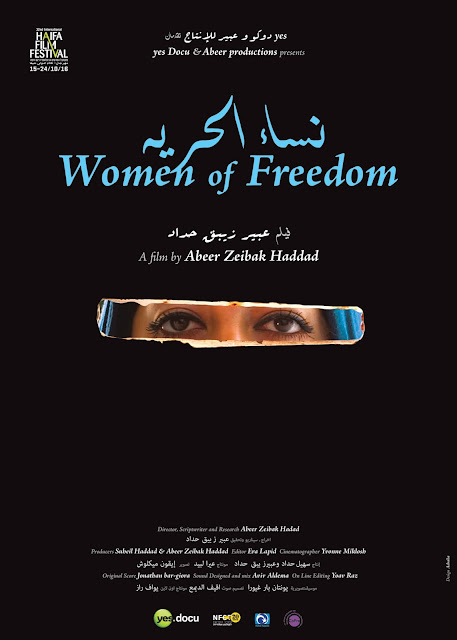
With her new film, Women of Freedom, Abeer Zeibak Haddad (who previously made Doma, about sexual abuse within the Palestinian community, which was reviewed on this blog in 2012) has created a hard-hitting documentary look at some of the issues and emotional personal stories of these honor killings. 


The film opens with a letter from a prisoner, a man who murdered his sister 17 years ago when he was 20 years-old.  Now, he realizes that he murdered her not for what she did or didn’t do but out of his own “despair, weakness and ignorance.” 

This film is filled with heart-breaking stories of young women and their families. The women are attacked for diverse reasons -- for wanting to break off with an abusive fiancé, for contemplating marriage with a non-Muslim, or for allegedly having sexual relations out of wedlock.  Members of the family feel that they must deal with these transgressions – no matter how insignificant – with their own hands. 

We meet the parents of Alaa, from Haifa, who studied to be a dentist.  They are compulsively caring for her gravesite. In another family, Rim went to the police to report that she felt threatened by her four brothers.  The police sent her home and she was murdered a few hours later. 

We also meet some women who have survived attacks by members of their families.  Halaa was attacked by her own knife-wielding father, but her aunt succeeded in stopping him. She explains that if you do something that seemingly only affects your own life, all of your extended family looks at it as something that also affects them. In fact, it reflects on them.  “If I make a mistake, everyone will get hurt.” In another example, Amal was purposefully hit by a car.  She was battered and bleeding but she survived.  She asks, why doesn’t our society defend its women?  She says her brother has destroyed her life and her dreams and she refers to herself as an “unburied corpse.”
 
This is a particularly artistic and human film, but Haddad has decided to also include statistics:  58% of Palestinians think that if a woman is murdered, it’s her own fault; 55% support the “honor” killings; 51% believe that the killers should not be brought to justice.  Haddad herself is haunted by a gruesome story from 40 years ago of a young woman whose grandmother crept into her bedroom at night and poured mercury into her ear.   She died shortly thereafter.

In my opinion, the name “honor killings” is a misnomer for two reasons.  First of all, how can it ever be a matter of honor to murder a young woman?  Secondly, it is important to note that not all of these women have been killed for allegedly bringing shame to their families.  Some of them were killed for other reasons, but the Israeli Arab community is suspicious that the Israeli police has been classifying the murders as honor killings as an easy way for them to ignore murders within the Arab community.

An extraordinary film, Women of Freedom (documentary, 57 minutes) provides a sensitive and substantive look at a terrible phenomenon that is continuing, without any seeming end in sight. The film is available from Journey Productions at www.journeyman.tv or contact the filmmaker Abeer Zeibak Haddad at suheilh@zahav.net.il.

Sunday, May 21, 2017

Grassroots Movement for Peace and Reconciliation

The film, The Field by Mordechai Vardi, is mostly about Ali Abu Awaad, a Palestinian, living in Beit Ummar near Gush Etzion junction, on the road that links Jerusalem to Hebron.  Abu Awaad believes in non-violence and learning to know the other and he is one of the founders of “Shorashim (Roots)”, a joint project of Palestinians and settlers in the Gush Etzion region. 

When he was a child, Abu Awaad’s mother was jailed for five years as a Palestinian activist.  He also sat in prison during the first intifada and lost a brother in the violence. 


This film is mostly about him and about the discussions that take place at the family’s field.  Located in the West Bank, within the heart of the conflict, there are also many Jewish activists who we meet in the film – Rabbi Avia HaCohen, Rebettzin Hadassah Froman (widow of the famous Rabbi Menachem Froman), Shaul Judelman, Rabbi Hanan Schlesinger and some others, mostly from the Jewish settlements in the Gush Etzion bloc.

Abu Awaad has permitted Israelis to erect a memorial on his land to the three boys who were kidnapped and murdered near there a few years ago and we watch as some of the parents of the boys come to meet Abu Awaad at this new memorial site. This is one of the most moving sections of the film.

He is particularly eloquent and he tells the Jews who come to hear him: “you want to stand in the shoes of the other, not to lose your identity but in order to engage him”.  His brother Khaled is also active and he talks about the despair among the Palestinian youth.  One of his sons is in jail and the other was hurt in a clash with Israeli soldiers and is now handicapped. 

The Abu Awaad brothers do not believe in going back in history and arguing over whose narrative is the right narrative.  Instead, they say we have to see each other as human beings and move on from there.

But do they have any followers? We don't know this from the film, but it seems that they are practically alone –and not terribly accepted—in Palestinian society.

And do the Jewish settlers—who are pioneers in this new movement of dialogue and reconciliation—have any traction in their communities?

Moreover, it is not entirely clear what the real purpose of this organization is. Is it to meet and learn to recognize the pain and suffering of the other?  This is a good first step, but is it enough?

Or, can we look forward to larger scale activities in the future?  Can these small numbers of Jewish settlers and Palestinian non-violent reconcilers actually have any impact in their communities, which are largely resistant to their activities? This would certainly be an important and welcome development, if they can pull it off.


The Field (documentary, 82 minutes) premiered at DOCAVIV a few days ago.  It is available from JMTFilms. 

Sunday, January 15, 2017

Espionage, Collaborators, and Terrorism

If you are a fan of the thriller, then the Israeli TV series, Fauda, directed by Assaf Bernstein, is for you!  According to the producers of the series, it is based on real-life episodes from their army service as members of an elite unit doing undercover work in the West Bank.  The title of the series means “chaos” and refers to what fighters of the Israeli Secret Service (shin bet) shout into their cellphones when they get into a difficult situation and need back-up.
 
The narrative is about a unit of shin bet counter-terrorism soldiers, hunting down a Palestinian terrorist who is running from one hideout to another, in an attempt to save his own skin and to mastermind another large-scale terrorist attack.  We get to know the fighters on both sides, both Palestinians and Israelis, and their families, their vulnerabilities, and their heroics.  On the Palestinian side, we realize that there are different factions within the terrorist network.  And on the Israeli side, we learn about the tremendous bravery which becomes an obsession as the shin bet undercover agents spend their lives passing as Arabs and penetrating into Palestinian society.

Fauda is a thriller, gritty, hard-hitting, and extremely well-made with complex characters and an authentic script.  I just finished bingeing on the first season – and I was happy to hear that a second season is in the works! You can catch the first season of Fauda on Netflix!

If you like action films, you might want to see Bethlehem by Yuval Adler, previously reviewed on this blog.

Saturday, July 19, 2014

Self-Made


Self-Made בורג  is Shira Gefen's second feature film, which premiered at the Jerusalem Film Festival, this week.  Her first film, Jellyfish (Meduzot) , she made together with her husband, Etgar Keret.

Self-Made is about two women, one Palestinian and one Jewish, both of whom are having difficulties managing their personal lives.  Michal is a highly successful and renowned artist whose bed breaks one morning and she hits her head and loses her memory.  She calls the furniture company and orders a new bed but is unable to manage to put it together.  Nadine works for the same furniture company, packing the screws at their plant.  She uses the screws like crumbs, dropping them along the way as she walks to and from her work.  Both women have lost their way.  

Self-Made encourages critical thinking on political issues.  The two women lead similar and parallel lives - yet the Israeli artist who cannot find her way still lives a life of privilege; one which the Palestinian woman covets.  Much of the movie takes place at the check points where we empathize with Nadine's humiliation and frustrations and observe  the political apathy and self-involvement of the Israeli youth assigned to work there.   In fact, one of the young soldiers at the checkpoint is so upset that she can't go home for the weekend that she aims her gun at helpless women and children waiting to pass through. Later, we see how she only cares about herself -- she states that she couldn't care less if the occupation ends since her army service is soon coming to a close.
The film also deals with issues of gender.  Michal has created a controversial piece of installation art, having undergone surgery so that she could use her own womb as part of the exhibition.  Nadine, on the other hand, is a single woman who is obsessed with her desire for a baby.  An example of an interesting visual image here is when Michal is putting together a baby's crib, it looks like she is behind bars, certainly a comment on how having a baby limits the freedom of a woman.  When Nadine, however, is working on the same crib, the camera angle shifts and the suggestion is that having a baby would actually help free her from the restrictions of Palestinian society.  
There are also interesting visual images dealing with the political side of the film, such as a bulldozer outside the window, which in our minds is connected to the violent dismantling of Palestinian houses.
Due to a soldier's simple mistake at a checkpoint, Michal is sent to Nadine's refugee camp and Nadine is sent to Michal's home in Jerusalem - or perhaps this happens in their fantasy.  Either way, the viewer watches as each woman discovers amazing fulfillment in the life of the other.  
Unfortunately, the film includes the token suicide bomber, which seems a bit banal today, since so many films have already dealt with what motivates a suicide bomber, and also because we haven't seen many suicide bombings in recent years.
Self-Made is produced by Movie Plus Productions and distributed by United King Films.


Saturday, January 4, 2014

Omar by Hany Abu-Assad


Hany Abu-Assad's newest film, Omar (2013), is a hard-hitting and powerful feature film.  His previous films, Paradise Now (feature film nominated for an Academy Award, 2005) and Ford Transit  (faux documentary, 2002), are also about the hardships of the Occupation.  All three of these films are Palestinian productions.  Even though Abu-Assad lives in Holland, the film Omar was almost completely funded by Palestinian businessmen and the major crew members were all Palestinian.  

Omar is a love story.  It is also the story of the struggles and insanity of life under the Israeli Occupation.  According to the filmmaker, Hany Abu-Assad, who spoke at the premiere screening at the Jerusalem Cinematheque: 

My only focus was to make a movie about the love story, friendship and trust.  

He went on to explain that the political reality was meant to be context.  The film shows how the political/national reality strongly affects the lives of individuals and the film's premise is that the terror of the occupation has caused these individuals to live with so much distrust, betrayal and paranoia  -- but ultimately, the real betrayal is not a political one but rather is connected to the love story. 

Omar, Tarek and Amjad are close friends.  Omar is in love with Tarek's sister, Nadia, and he climbs the separation wall, taking great risks, in order to visit her.   As a result of the humiliation and degradation of regular life in the West Bank, the three friends decide to commit an act of violent resistance.  When the filmmaker was asked whether his film supports the resistance to the occupation, he stated unequivocally that it is the primary message and that "injustice requires resistance."

Omar is played by Adam Bakri, one of the sons of Mohammed Bakri, and it is clear to see that he is as good looking and as compelling an actor as his father.  He plays a baker -- someone whose life is devoted to making bread, nurturing and satisfying a basic human need.  He is a tragic figure -- a moral, sensitive and beautiful human being who makes self-destructive choices in his life.

These are the major threads of the film -- Omar's love story, the senseless act of violence committed by him together with his friends, and the resulting savage beating and harassment that he receives by the Israeli Security Services (Shin Bet).

Many people are comparing this film to the Israeli thriller, Bethlehem (previously reviewed on this blog), which is about the relationship between a Shin Bet handler and his Palestinian collaborator.  The major difference is that since Omar is a film made from a Palestinian perspective, the main character, who is also being recruited by the Shin Bet to become a collaborator, never betrays his own sense of morality, never betrays any of his friends, and never collaborates in any way.
    
 The film includes much tension and violence -- on the part of the Shin Bet, the Israeli  soldiers, and also among the Palestinians themselves -- and therefore some might find it troubling.  However, the film, which has already won accolades around the world and is on the list for an Academy Award nomination, offers an important reflection of the tragic choices that regular people are being forced to make as part of their lives in the West Bank.