"World Cinema: Israel"

My book, "World Cinema: Israel" (originally published in 1996) is available from Amazon on "Kindle", with an in-depth chapter comparing and analyzing internationally acclaimed Israeli films up to 2010.

Want to see some of the best films of recent years? Just scroll down to "best films" to find listings of my recommendations.

amykronish@gmail.com

Showing posts with label surrender. Show all posts

Wednesday, August 9, 2023

The Stronghold by Lior Chefetz

Next month we will be marking the 50th anniversary of the 1973 Yom Kippur War.  It is interesting that not many feature films (except for Amos Gitai’s Kippur) were made about this war.  The war in Lebanon, in contrast, had the honor of having a plethora of films made on the subject.  Perhaps this is because the Yom Kippur War was a trauma in our past and filmmakers were unsure about dealing with the sacred cows of heroism and martyrdom on the background of such trauma.  This year, however, we have two important films that deal with that time.  The first is the international feature film, Golda, starring Helen Mirren and directed by Guy Nattiv.  The second is The Stronghold (המזח), directed and written by Lior Chefetz, about heroism and surrender, on the background of the Yom Kippur War.

The Stronghold is based on a true story, inspired by a book by Dr Nahum Werbin, about soldiers during the Yom Kippur War who fell into the hands of the Egyptians, and after 40 days in captivity were eventually returned to Israel in a prisoner exchange. Dr. Werbin became a well-known surgeon at Ichilov hospital in Tel Aviv. In this story, based on true events which took place at a desolate outpost on the famous “Bar Lev line”, the soldiers, under surprise attack, are forced to decide whether to follow the leadership of their young and idealistic commander or whether to listen to the more level-headed doctor who is doing reserve duty at their outpost.  This results in a test of their deepest values. 

The story moves forward and backward in time – therefore there are no spoilers -- switching between the war and events that followed it, including the captivity, the interrogations of Dr. Werbin after he returns from 40 days in Egyptian captivity, and the anxiety and worry of the soldiers’ families back home.  According to the filmmaker, “The personal events blend with the national ones in order to create a rich and emotional experience… This conflict is especially relevant today, since the Israeli experience is built around that tension between the individual and the nation: the rights of the individual to freedom and independence, and in the face of mutual responsibility and sacrifice for the benefit of all.”

This is a hard-hitting war film, with all the grit and grime and blood that goes along with war.  It is extremely well-done – the acting, the screenplay, the directing, and the editing are all excellent.  If you liked Michael Aloni in Shtissel and in Beauty Queen of Jerusalem, you’ll appreciate him here, as the complex main character, Dr. Werbin, who is assigned in his reserve duty to report to this outpost, on Erev Yom Kippur. 


The film provides in-depth characters -- there is Shlomo, the young commander of the outpost, whose father is a survivor of Auschwitz, and is so proud of his son, an officer in the Jewish army; there is the radio operator who wants to study art; there is Avihail, the young religious soldier assigned to the outpost from the rabbinate; and there is Dr. Nahum Werbin whose wife is pregnant with their first child.  He is working desperately to save the lives of the wounded and to prepare them for evacuation.  But no reinforcements are forthcoming, and there is no evacuation on the horizon. 

As the days go by and there are no medical supplies left, and little food and ammunition, Shlomo is faced with an impossible decision.  The higher command has put the decision about surrender in his hands.  On the one hand, he has been taught to fight to serve his country, and never to surrender.  On the other hand, he has a responsibility to protect the lives of his soldiers. 

Another recent film, Image of Victory, directed by Avi Nesher, is also about surrender in wartime and about the failure of the Israeli military command to provide full support for the soldiers – both in battle and in surrender. 

According to Nahum Barnea, veteran political columnist for Yediot Aharonot (August 4, 2023), who attended the premiere screening in Tel Aviv, the Stronghold is about whether a soldier has to dedicate his life to his country, or whether his country should give him full support and dedicate itself to him. He explained that this contract is relevant also today as we turn our attention to reserve soldiers who oppose the judicial coup and are threatening to stop volunteering in the reserves. He concluded with: “Fortunately, the drama that took place at the outpost, did not result in a second Masada (a national suicide), rather sanctity of life was victorious over our obsession with heroism.”

The film was dedicated to the filmmaker’s father who served in the Yom Kippur War as a physician in Sinai. Therefore, according to the filmmaker, he was “acquainted with the values and dilemmas of the world of military medicine,” and when he read Dr. Werbin’s memoir, he knew that he had to adapt it into a film.

 As a member of the committee of the Film and Media Collaborative (made up of representatives from three funds: Gesher, Maimonides, and AviChai) which entertains proposals for funding of Israeli films, I am proud to say that we funded this film! It is an inspiring film about critical dilemmas in Israeli society, which also carries a strong  message about the sanctity of life.


Wednesday, February 23, 2022

A New Film by Avi Nesher - Image of Victory

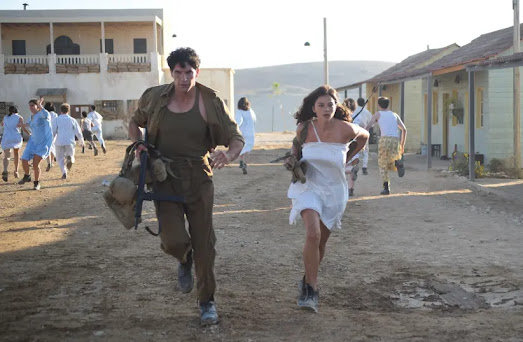
Avi Nesher’s new high-budget and powerful film, Image of Victory (aka Portrait of Victory) tells two parallel stories about a battle of the 1948 war, particularly how the Egyptians conquered Kibbutz Nitzanim.

The film opens in 1978 when peace is announced between Egypt and Israel.  A successful Egyptian journalist remembers back 30 years to a battle during the 1948 war when, as a young man, he had been sent, with a cameraman, to shoot propaganda newsreels which would portray victorious moments that would help King Farouk with his popularity.  He remembers back to a battle against Nitzanim. At that time, Nitzanim was a small kibbutz outpost (on the southern border with Egypt).  The young kibbutz members and the army irregulars were poorly trained, naïve and idealistic. They were up against the fedayeen and then later, up against the better equipped Egyptian army.

The film is based on a true story of the defeat of Nitzanim.  At that time, the kibbutz was outnumbered by the powerful Egyptian army, but members of the kibbutz were told to hold the line.  Their eventual surrender, even after many were killed in the fighting, was seen as a shameful defeat, leaving a black mark on the history of the State of Israel, according to normative Israeli history.  This film was meant to redress that terrible historical black mark. The film was billed in the media as an anti-war film but it seemed to me to be much more of a nationalist telling of the “real” story of what happened at Nitzanim. It makes some of the kibbutzniks and soldiers into heroes and heroines, despite their defeat.

I really liked the fact that two parallel stories are offered.  One story is that of the journalist who is dedicated to making a serious film, using also a love story as a hook to bring in the Egyptian audience, but is forced to create army propaganda.  The second  is the story of the kibbutzniks, as personified in Mira, an extremely motivated and independent young woman, the radio operator for the kibbutz, willing to die in defending her community.   These two stories are somehow connected since the journalist and his cameraman have their eyes on Mira, throughout the whole film, as if to put a human face to the enemy.


Overall, I feel that it was a good film but not a great one. Many of the characters were lacking in depth, and the script was often childish. Nevertheless, it was a moving and authentic re-enactment of an important part of the War of Independence, with a new twist. It was particularly fascinating to get a glimpse of how some Egyptians saw us during that war, as not much more than a bunch of colonizers who were settling on contested land. Bringing the Egyptian narrative into the film was an important innovation—it allowed us to see “the other side” for once in one of our wars, and help us get some insights into what they were thinking and feeling.

Without offering a spoiler, history has taught us that Israel lost the battle for Nitzanim, but Egypt never succeeded in its main goal of destroying Tel Aviv (and eliminating the state of Israel!) and therefore Egypt (and the other Arab countries) lost the war, even though they won this particular battle. Historians in Israel in recent years have revealed that even though the Arab armies were larger and better equipped (as we saw in this film), the young Israeli army was better organized, which was one of the main reasons that it was able to be victorious.

Avi Nesher is a highly acclaimed filmmaker and many of his films have been previously reviewed on this blog.  In his earlier period, in the 70s, he made Sing Your Heart Out (The Troupe) and Dizengoff 99.  After a long period of filmmaking in Hollywood, he returned to work in Israel and made Turn Left at the End of the World (2004), Secrets (2007), Matchmaker (2010), Wonders (2013), Past Life (2016), The Other Story (2018).