"World Cinema: Israel"

My book, "World Cinema: Israel" (originally published in 1996) is available from Amazon on "Kindle", with an in-depth chapter comparing and analyzing internationally acclaimed Israeli films up to 2010.

Want to see some of the best films of recent years? Just scroll down to "best films" to find listings of my recommendations.

amykronish@gmail.com

Showing posts with label Arabs of Israel. Show all posts

Tuesday, July 14, 2026

"Amal" - a new film about violence within the Arab community of Israel

Amal, by Sharon Azulay-Eyal, David Ofek, Nahad Bashir, is a new Israeli feature film which premiered this week at the Jerusalem Film Festival.  The film deals with violence within the Arab community.

Today, when we think about violence in the Arab community, we think about gangs extorting businesses for protection money and shooting anyone who refuses to cooperate.  But this film is about something else – the cycle of revenge shootings between two families who have a long-standing disagreement between them.  Unfortunately, it leaves out this wider context, which might have helped viewers in Israel and abroad get a fuller understanding of this serious problem in Israeli society today.

Amal and Hassan are happily married with three children, living in a village in the Galilee. They both work at a nearby moshav for a Jewish family which runs B&B units. Hassan’s brother was murdered a number of years ago. When the murderer is released from prison, violence and revenge begin to endanger Amal and Hassan and their family and even overwhelm their lives.  


The culture of revenge is seen by the men in the story as one that you cannot stop.  Only the women seem to feel that reconciliation and peace-making could work.  The hard-hitting story and complex script is told with a lot of compassion and the viewer feels strongly for Amal and the dangers that her family faces.

It’s important to note that the Arabic name “Amal” means “hope”. However, this film does not offer much hope. Just pain. One feels empathy for those who suffer in this film, especially for the women and children, but the film ends on a note of despair.

Some feel that there is not much than can be done to solve this problem in Arab society.   Actually, the great rise in crime in the Arab communities of Israel in recent years is due to the policies of the current government, especially those of Itamar Ben Gvir, Minister of National Security, and by his policy of non-enforcement by the Israeli Police, thereby permitting most murder cases in the Arab community to go unsolved.


Wednesday, January 4, 2023

A New Children’s TV Series about the Bi-Lingual School

Last week, my husband Ron and I saw a preview of the first two episodes of the new television series called Madrassa, which is a TV series about Arab and Jewish kids studying together in a bi-lingual school in Jerusalem. This new series, written by the well-known Israeli Arab author Sayed Kashua (Dancing Arabs 2002, Track Changes 2020) and directed by Gur Alfie, an Israeli actor, comedian, writer and director, is a new joint project of Educational TV in Israel and the Arabic TV channel in Israel, called Makan 33. Ron and I wrote this review together.

While this TV series is completely fictional, it is important to state that there is a bi-lingual school in Jerusalem, from kindergarten through 12th grade, which is part of the Hand in Hand Educational Network that promotes Arab-Jewish Education in several locations in Israel.

Madrassa (in Hebrew and Arabic, as is the school that it depicts) was humorous, insightful (stereotypes notwithstanding) and even poignant.  The episodes that we viewed were very well done. They grappled with serious issues that Arab and Jewish students face, especially in their high school years, as they learn and socialize together. In addition, the series is done with a sense of humor, which is the well-known style of Sayed Kashua which we remember well from his popular television series, Arab Labor (previously reviewed on this blog), which ran for several years in Israel and which was translated into English for viewers abroad, who wanted to learn about relations between Arabs and Jews in Israel.

Following the screening of the two episodes, we listened to a panel of some of the bright, vivacious young Israeli Arab and Jewish actors in the series. Just seeing them together on the stage, so friendly and cooperative, was symbolic of their positive experience in making this series together, which they clearly all enjoyed. They are now friends from doing this.

Moreover, they had important things to say to us. For example, there was an issue raised in one of the episodes of a high school girl who decides to come to school at the beginning of the new school year wearing a hijab (a Muslim head covering) which is a great shock to the secular Arabs and Jews who are her friends in the school on the TV program. We learned from the actress who played this girl that this was based on a real story in the actual school. One of the male actors, who graduated from the Hand in Hand school in Jerusalem told us that this was an issue because most of the students who attended the school, from both sides, were secular, and it took some time for them to learn to live with a religious student in their class.

Another actress was asked about how she felt about dealing with these sensitive issues with a sense of humor. Her answer was poignant: “It is better to have love than hatred!” This basically summed up her attitude to the whole series. She sees this as the message of the series.

The young actors and actresses –who are clearly very much involved now in this show—were interviewed by an Israeli website called Serugim where they spoke similarly about how much they enjoyed making this series together and how important the message of mutual understanding is for Israeli society today. Among other things they said: “We hope that the viewers will laugh and love—it’s all permissible.” They have imbibed Sayeed Kashua’s method and message of using humor to help deal with difficult issues. Since the screening of these initial episodes, they have been interviewed in several Israeli websites and newspapers, which is an indication that this series is already beginning to make some noise in Israeli society, which is a good thing! In one of the interviews, for the website called Walla, the authors of the article say that with all the dilemmas and difficulties involved, this series “points to an alternative way” for Israeli society.

This series will now be screened on Educational TV and Arabic TV in the weeks ahead. It will also be streamed.  In these difficult days, with the rise of an extreme right-wing government in Israel, we hope it promotes greater understanding among Arabs and Jews in Israel.

The series is available from Go2Films. 

Tuesday, February 1, 2022

Tantura, The Story of an Arab Village from 1948

Tantura, directed by Alon Schwarz, is a new meticulously-researched documentary film which tells a disturbing story from the 1948 war, including a shocking and senseless killing, and a massive cover-up in its wake.  The film includes interviews with perpetrators, victims and witnesses (many now more than 90 years old), recreations, and never-before-seen archival material from the 1948 war.

The Arab village of Tantura was located on the coast, a bit south of Haifa, near Zichron Ya’akov, where Kibbutz Nachsholim and Dor Beach are located today. The soldiers of the Alexandroni Brigade conquered the village in 1948, and the surviving villagers were expelled – some of them across the border.  There had always been rumors of a massacre there, and in the 1990s, Teddy Katz, a graduate student at Haifa University, interviewed more than 130 people – both Jews and Arabs – as primary research material for the writing of a Master’s thesis.  He stated in his thesis that not only were the Palestinians of Tantura expelled from their village, but there was also a massacre of perhaps as many as 200 unarmed men which took place after the conquest of the village was concluded. 

A conspiracy of silence had been created by the veterans of the Alexandroni Brigade.  At the time that Katz’s thesis became public through a report in an Israeli newspaper, members of the brigade’s veterans’ association sued Katz in civil court for libel, forcing him to deny his academic findings and to apologize saying that no massacre had taken place. 

Now, more than twenty years later, filmmaker Alon Schwarz provides the viewer with an enormous body of testimony – using the original audio recordings from Teddy Katz’s research, original documents and also contemporary interviews -- in order to build a story of what happened in that village so many years ago.

This film is part of the ongoing story of the Nakbah, the Arabic word for “catastrophe”, which refers to the terrible tragedy that befell the Palestinian people during the 1948 war, in which hundreds of Palestinian villages were destroyed.  In some cases, the villagers fled, but in many other cases Palestinians were expelled or forced to flee by intimidation.  Later on, tractors were sent in to demolish the villages. As if this was not enough, there were also terrible atrocities that occurred – senseless killing of unarmed villagers, looting, and cases of rape. 

But Israelis like to think of themselves as the under-dog in this war. Also, atrocities were committed not only by Jews but also by Palestinians in that very difficult war. Nevertheless, an entire myth of denial of the Nakbah has been built up in Israeli society which includes the refusal to teach about it in Israeli schools and the claim that the Israeli army is the most moral army in the world.  During wartime, however, armies by definition do many immoral things.  Apparently, the Israeli army in the 1948 war was not immune to such acts.

Many questions remained in my mind after viewing this difficult film: can Israeli society acknowledge the destruction of the village of Tantura, the massacre, the expulsion and the ensuing years of denial? Will grappling with the terrible atrocities committed during the 1948 war help us to move on?  Will it help the descendants of Tantura come to terms with what happened there?  As journalist Gideon Levy wrote last week in Ha’aretz, won’t this help to lay the ghosts of the past to rest?  Perhaps this film could be the first step along the path of mutual recognition of past sins, similar to the Truth and Reconciliation commission of South Africa.

The film Tantura (documentary, 90 minutes) was produced with funding from two Israeli mainstream bodies: HOT cable TV and the New Fund for Cinema and TV.  The film is available from Reel Peak Films. 


Monday, February 10, 2020

The Dead of Jaffa by Ram Loevy


The Dead of Jaffa  by veteran TV filmmaker, Ram Loevy, is a hard-hitting feature film about how our contemporary reality is haunted by those who have come before us, in this case specifically the Arabs of Jaffa who lived during the British Mandatory period of 1948.

The story is about Rita and her husband George who is the proprietor of a small shop.  One day, three children from a small West Bank town near Hebron are smuggled into Israel and dropped off at their house.  Their mother is dead and their father is serving a life sentence in an Israeli prison. Rita and George are told that these are the children of a distant relative.  Whether they are or they aren’t, George is terribly worried about the risks involved in harboring three undocumented children. But George and Rita are childless and Rita is not willing to give up the children so easily.

The two younger children are happy to become part of George and Rita’s household.  But the older boy, whose political consciousness is already developing, has moved out of their house into an abandoned house next door.  George tells him that this is where dead people live, which we take to understand that it belonged to Palestinians who left in 1948.  As the boy looks out of the window, he magically witnesses the 1948 period, and watches as Palestinians in traditional dress are moving around, preparing for a celebration.  A whirling dervish begins to dance, and is supernaturally flying above.  These figures are not actually ghosts from the past, rather they are part of a foreign film which is being shot in the old part of Jaffa – a romance about what it was like living under British occupation during the 1948 period.

George is cast as a distinguished Palestinian doctor and we watch as his character is shot and killed, in multiple takes, by a British soldier.  This is not the strongest part of the film, perhaps because Ram Loevy has purposefully created the film-within-a-film to look somewhat stiff as a reflection of the lack of understanding of the foreign filmmaker.  The tension between the historical period and the modern one reaches a climax when a staged anti-British demonstration gets out of hand and becomes a violent demonstration against the Israeli occupation.  This is when the viewer realizes how the memory of the trauma and hardships of 1948 is actually part and parcel of the contemporary reality.

Ram Loevy is known for his wide array of films dealing with difficult political and social issues including discrimination, poverty, economic and social inequality, and difficulties between Arabs and Jews.  Loevy is perhaps best known for his 1978 made-for-TV film, Khirbet Hiza’a, based on the story by S. Yizhar (an author of the Palach generation). The film is set during the 1948 War of Independence between Israel and the surrounding Arab states, in which Israeli soldiers forcibly deport the citizens of an entire Arab village.  Remarkable for its honesty and openness at a time when the onscreen examination of Arab-Israeli issues was still rare, the film portrays the impotence of one soldier who challenges the others about what they are doing, but is quickly silenced by another soldier’s vision of the Land of Israel becoming filled with inevitable waves of Jewish refugees who will replace the “fleeing” Arabs. 

The Dead of Jaffa is available from Laila Films.

Wednesday, June 12, 2019

Tel Aviv on Fire


Tel Aviv on Fire, directed by Sameh Zoabi, opened this week in Israeli movie theaters.  It has already garnered awards both in Israel and abroad. The film is a superb satire about the absurdity of the Occupation, the humiliation of the checkpoints, and the chutzpah of some of the Israelis who try to make decisions for the Palestinians about what is best for them, especially IDF officers at the checkpoints.

Working for his uncle on a Palestinian soap opera, Salem has to drive regularly from Jerusalem to Ramallah to be on the set as a Hebrew dialogue consultant.  The soap opera is set on the background of the Six Day War of 1967 and is apparently popular with both Jewish Israeli and Palestinian Israeli audiences. The story is about a Palestinian woman terrorist/freedom fighter (depends on your point of view) who is assigned to seduce an Israeli general.

As Salem advances to become a scriptwriter for the TV series, we watch as he takes the story from real life and adapts it cleverly for the TV screen.  There is some romance – both in the story of the soap opera and in Salem’s own life. Yet, the strongest parts of the film can be found in the political commentary (some of it not-so-subtle, in fact quite sharp and biting), especially in the comments of the uncle about the ongoing Occupation which controls so much of Palestinian daily life in East Jerusalem and the West Bank. In addition, the film has a brilliant ending, which I will not reveal here, but leaves the viewer with the realization that the struggle by Palestinians against the Occupation will continue until it is over.

The actors in this film are all excellent, especially the lead Palestinian actor, Kais Nashif, who plays his role as someone who is seemingly aimless and easily led by others. Things get a bit out of hand when Salem turns to the commanding officer at the checkpoint -- where he finds himself humiliated on a daily basis – for advice on the character of the 1967 Israeli general.  As a result, we find Salem caught between the checkpoint officer’s view of things and his uncle’s need for underlying messages supporting the Palestinian struggle.

The filmmaker, Sameh Zoabi, is a Palestinian Israeli, who grew up in Iksal, an Arab village in the Galilee, and lives both in the USA and Israel. In a feature article by Nirit Anderman about him which appeared in the Haaretz magazine in Hebrew and in the English Haaretz this week, he shared some of his thoughts about making this film.  When asked about his responsibility to his people as a director and screenwriter, he responded, “I try to create from a very personal place… We have a greater responsibility than Jewish Israelis because our narrative is not so well known.”


Wednesday, May 9, 2018

New Israeli feature film looks at racism within our society

The Cousin, directed by and starring Tzahi Grad, is a new feature film about relations between Arabs and Jews within Israel. 

Naftali lives with his wife and two kids on a moshav in rural Israel. Naftali, an actor and filmmaker, is a bit of a naïve fellow, dreaming of drawing tens of thousands of Israelis and Palestinians into one-on-one encounters in order to advance the peace process. 

Near his house he has a studio in an old cottage which badly needs renovations and he hires a young Palestinian named Fahed to do the renovations.  Fahed is a Palestinian of Israeli citizenship and Naftali explains the difference between a Palestinian from the Territories and one from inside Israel to his children. 


That same morning, a local girl is assaulted and, not surprisingly, the local police jump to accuse Fahed.   When Fahed is released on the cognizance of Naftali, members of the local community get together and decide to take matters into their own hands. 

The film depicts Naftali as a moral person, one who cares about Arabs and wants to combat negative stereotypes about them. As the plot develops and the tension mounts, Naftali is threatened by his neighbors who pressure him to stop protecting Fahed. Although he is a compelling character, he is also beset with ambivalence. As things begin to spin out of control, we see how he blunders from event to event, and how he is especially caught off-guard by his wife’s mixed reactions to his attempts to protect his new worker. 

Afraid of being too preachy and wanting to produce an entertaining film, the filmmaker misses the mark by concluding with a surprising and ironic twist which leaves the viewer asking what happened to the naïve optimism of our main character and wondering whether racist violence can be curbed in our society.

The Cousin was produced by Bleiberg Entertainment. 

Sunday, July 16, 2017

Holy Air is a debut film, directed, written and starring Shady Srour.  In some ways this episodic comedy is similar to the films of Elia Suleiman – about a Christian Arab from Nazareth who is caught between his heritage (as represented by his relationship with his seriously ill father) and his biting and insightful look at his surroundings.  Also, similar to the films of Elia Suleiman, this one also has a dark side to it, seemingly pessimistic about the possibility of life here in the Middle East.

Holy Air is about a man named Adam.  Although he is a Christian, his name implies that he represents “every man”.  Just a typical guy, he is more interested in sex with his wife than just about anything else.  Having just learned that his wife is pregnant, he is trying desperately to find a way to support his family.  In addition, he is quite surprised to discover his own violent side, and he is critical of just about everything around him.  The film pokes fun at road rage, the Jewish establishment, the Muslim protection rackets, and the local church!

Adam has a great idea to make a lot of money – selling the very same air breathed by the Virgin Mary.  He “packages” and “bottles” the air and begins to sell it to tourists.  When he discovers that business is not really as simple as it seems, he works to bring together the Israeli Minister of Tourism, the hierarchy in the Catholic Church, and the head of the Nazareth Muslim mafia, all banding together for the sake of profit. 

This satire was funded by the Gesher Multicultural FilmFund!  I sit on the board, and I’m pretty proud of the diversity and quality of the films that we have funded. For distribution information, contact treem@orange.net.il

Monday, June 19, 2017

So-called Honor Killings

Here in Israel, the subject of so-called “honor” killings has been in the news a lot lately.  It seems that a surprisingly large number of Palestinian women have been murdered and all-too-often their murderers have not been apprehended.  Just this week, the headlines have been filled with the story of a 19-year-old woman who was murdered by her uncle in the northern Negev.  Both the Israeli and Palestinian Authority police have been trying to deal with this phenomenon but have not had much success.  In fact, the numbers of young women falling prey to this type of tragic end has risen in recent years. 

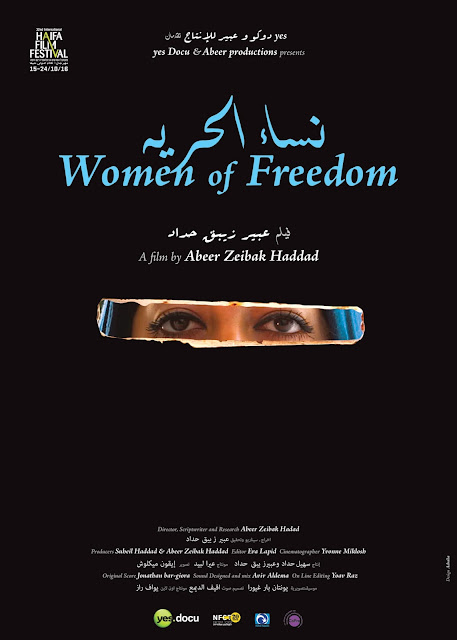
With her new film, Women of Freedom, Abeer Zeibak Haddad (who previously made Doma, about sexual abuse within the Palestinian community, which was reviewed on this blog in 2012) has created a hard-hitting documentary look at some of the issues and emotional personal stories of these honor killings. 


The film opens with a letter from a prisoner, a man who murdered his sister 17 years ago when he was 20 years-old.  Now, he realizes that he murdered her not for what she did or didn’t do but out of his own “despair, weakness and ignorance.” 

This film is filled with heart-breaking stories of young women and their families. The women are attacked for diverse reasons -- for wanting to break off with an abusive fiancé, for contemplating marriage with a non-Muslim, or for allegedly having sexual relations out of wedlock.  Members of the family feel that they must deal with these transgressions – no matter how insignificant – with their own hands. 

We meet the parents of Alaa, from Haifa, who studied to be a dentist.  They are compulsively caring for her gravesite. In another family, Rim went to the police to report that she felt threatened by her four brothers.  The police sent her home and she was murdered a few hours later. 

We also meet some women who have survived attacks by members of their families.  Halaa was attacked by her own knife-wielding father, but her aunt succeeded in stopping him. She explains that if you do something that seemingly only affects your own life, all of your extended family looks at it as something that also affects them. In fact, it reflects on them.  “If I make a mistake, everyone will get hurt.” In another example, Amal was purposefully hit by a car.  She was battered and bleeding but she survived.  She asks, why doesn’t our society defend its women?  She says her brother has destroyed her life and her dreams and she refers to herself as an “unburied corpse.”
 
This is a particularly artistic and human film, but Haddad has decided to also include statistics:  58% of Palestinians think that if a woman is murdered, it’s her own fault; 55% support the “honor” killings; 51% believe that the killers should not be brought to justice.  Haddad herself is haunted by a gruesome story from 40 years ago of a young woman whose grandmother crept into her bedroom at night and poured mercury into her ear.   She died shortly thereafter.

In my opinion, the name “honor killings” is a misnomer for two reasons.  First of all, how can it ever be a matter of honor to murder a young woman?  Secondly, it is important to note that not all of these women have been killed for allegedly bringing shame to their families.  Some of them were killed for other reasons, but the Israeli Arab community is suspicious that the Israeli police has been classifying the murders as honor killings as an easy way for them to ignore murders within the Arab community.

An extraordinary film, Women of Freedom (documentary, 57 minutes) provides a sensitive and substantive look at a terrible phenomenon that is continuing, without any seeming end in sight. The film is available from Journey Productions at www.journeyman.tv or contact the filmmaker Abeer Zeibak Haddad at suheilh@zahav.net.il.

Thursday, January 19, 2017

Palestinian Israeli Women living in Tel Aviv

In Between (Bar Bahar), the debut film by Maysaloun Hamoud, is a compelling story about three Palestinian Israeli women, who are caught between their traditional society and the allure of the independent and open lifestyle of Tel Aviv.

Layla is a sophisticated lawyer.  She dresses beautifully and enjoys smoking, drinking, drugs and partying.  When she finally meets the man of her dreams, a handsome Arab filmmaker, it becomes obvious that he is not willing to bring her home to meet his parents unless she dresses like a traditional Muslim.  But Leila is not willing to change who she is and how she behaves for anyone.

Salma works as a barman in Tel Aviv, and comes from a conservative Christian family.   She and Layla host some of the best parties!  Salma’s parents are trying to find a suitable mate for her and are aghast to discover that their daughter is living a non-normative lifestyle. 

Nur is the most traditional of the three, wearing a hijab, and engaged to marry a religious man.  But she is disappointed to discover that he wants his wife to be a stay-at-home mom, even though Nur is completing her degree in computer science at Tel Aviv University.

These three women, although very dissimilar, are facing similar dilemmas about moving from the traditional requirements of life in the village to a more modern life in the city.  One of the highlights of the film is the way that the filmmaker makes these three apartment-mates work together in common cause, even though they are so different from each other.  They are all looking for a suitable partner and they are fluent in Hebrew and would almost pass in Israeli society except for the fact that they are proud Arabic speakers and never hide it.  In one humorous scene, a shopkeeper makes a face when she hears them speaking Arabic.  One of the girls says, don’t worry, we don’t bite! 

The filmmaker has chosen to portray men in this film in a very critical light.  The most compelling male figure turns out to be Nur’s very traditional father, who is loving and understanding of his daughter in the time of a crisis.  But, as part of the filmmaker’s criticism of the Arab patriarchal society, the other male characters are stereotypes of Arab men.  In fact, in a recent column in Ha’Aretz, Sayed Kashua wrote about how people from the Muslim city of Um el-Fahm are critical of the film. He explains that this is because one of the major male characters is a religious Muslim man from Um el-Fahm who turns out to be a chauvinist and a rapist.

In Between includes a lot of wit and charm.  Variety called it Sex and the City for Palestinian Israeli women living in Tel Aviv.  Although there is an extreme amount of smoking, drinking and drugs, I found it enormously enjoyable mainly because it provides a window into the problems of women trying to move from a traditional family life to a more independent one.


Monday, January 16, 2017

Family Relationships

Personal Affairs, debut feature film by Maha Haj, is about family relationships and loneliness, made with humor and charm.  Although it is slow-moving, and many sequences have a lot of quiet, the tone of this award-winning film is surprisingly compelling.
  
The story is about an older Christian couple, living in Nazareth.  The father is obsessed with the internet, the mother with her knitting and her soap operas.  They have three grown children, all of whom have moved away. Their daughter is married and almost ready to give birth, living in Ramallah.  Their two bachelor sons -- one lives in Sweden, another in Ramallah.  The vignettes are about relationships – between the parents, between the daughter and her husband, between one of the sons and the object of his love with whom he is incapable of making a commitment. 


At a premiere screening, last night at the Jerusalem Cinematheque, the filmmaker explained that she chose to use humor, because humor crosses borders.  She acknowledged that she shows moods and situations, but hesitates to provide answers as to what will happen or to offer a standard ending.  It is the situation, rather than the narrative, that is important.  She also said that she moves between imagination and reality, as does the film.

According to the filmmaker, the scenes of a dysfunctional family break the stereotype of the warm and supportive Arab family.  In fact, parts of the film border on the absurd, and the elderly grandmother provides comic relief. There are also subtle political comments in the film, and a strong feeling of claustrophobia, especially reflected in the son-in-law’s obsession with seeing the sea for the first time in his life.

This is a film about checkpoints and reality, but it is mostly about daily routine and dreams, about the dissatisfactions of everyday life, and the need to resolve inter-personal issues.

Personal Affairs was screened in Un Certain Regard category at Cannes and was the winner of the award for best Israeli feature film at the Haifa Film Festival.  Beginning March 2017, the film will be available from Sophie DulacDistribution.

Saturday, July 2, 2016

Palestinian Arab Citizens of Israel


Did you know that the Arab citizens of Israel, including Christians, Muslims, Druze, and Bedouin, make up 20% of the population?   

In the documentary film, My Home, filmmaker Igal Hecht raises a lively discussion about the racism that exists within Israeli society and, notwithstanding this reality, he shows that many of these Arabs citizens are loyal to the state of Israel.  We meet a diverse group of articulate  people, all of whom are seriously working towards coexistence and understanding, some of whom have served in the army, and all of whom support the State of Israel. 

Following Ariel Sharon's famous pilgrimage to the Al Aqsa compound (Temple Mount) in 2001, there was rioting among the Arabs of the Lower Galilee.  The violent response by the police against these rioting citizens caused the death of 13 young men.  In a democratic country, police do not usually open fire on their own citizens even if they are part of an active and even violent protest movement.  According to one woman, this destroyed something in the social fabric and the goodwill in the Galilee.  But she still lives a life which reflects her desire for coexistence.   

It cannot be denied that there is a certain amount of racism and discrimination smoldering -- sometimes below the surface, sometimes more blatant -- against the Arab citizens of Israel. Even the Druze and Bedouin, who serve in the army and believe in supporting the state, admit this and say that things must change.  We also hear from a young man whose father was a soldier in the Southern Lebanese Army (SLA).  After having been granted asylum in Israel,  they live in Acre and this young Christian man finds that he identifies with Israel and is thankful to Israel for having saved his family.  

The film also gives voice to other opinions, to people who are Palestinian Arab citizens and are very critical of how Arabs are treated in Israel.  For example, there are Arab members of the Knesset -- Ahmad Tibi, Ayman Odeh and Haneen Zoabi -- who are all very critical of the discrimination that Arabs suffer within Israeli society.  In addition, they speak out forcefully against the Occupation. 
 
Perhaps one of the things that points more than anything else to the xenophobia within the country is that a day before the 2015 elections, Bibi Netanyahu made a plea to Likud voters to come to the polls by announcing that "the Arabs are coming out in droves."  He was trying to ensure the election of his right-wing government.  It was a terribly shocking comment which drew a lot of criticism and he was forced to apologize for it.

The film My Home, directed by Igal Hecht (documentary, 52 minutes), is a fascinating documentary which reveals the complexity of life in Israel for its Arab citizens.  The film is available from Ruth Diskin Films.

Friday, May 20, 2016

Junction 48 by Udi Aloni


The prizewinning film, Junction 48, directed by Udi Aloni, is a great film of complexity and political depth, with lots of good music and talented young singers.  The film provides insight into the issues of Palestinian Israelis in the contemporary reality and is very critical of how the Palestinians of Israel are treated -- both socially and by the authorities.  

The story takes place in Lod, a mixed Jewish-Arab city in central Israel, where drugs abound together with poverty.  There is resentment against the Israeli authorities, tensions between different groups of Palestinians and Bedouin, and also between the local Jewish and the local Palestinian young people.

Karim's parents perform as a musical team, but Karim's music is different -- he does Arabic rap and the lyrics are biting and critical.  He performs with his brother and some other friends.  One of his friends lives in an old shack, which they are desperately trying to save from demolition  by government bulldozers.  Another friend is involved in the sale of drugs.   Karim's girlfriend, Manar, who also sings with Karim's rap group, is being pushed by her family to get married since she lives what they consider an immodest and dishonorable lifestyle.  

This is a film about the frustrations of living in a divided society, and about the meeting point between Israelis and Palestinians within Israeli society.  Uri Klein (in his Ha'aretz review of the film this past week) calls this the collision and interaction between Israelis and Palestinians. When Karim's rap group gets a gig to perform in a Jewish rap club in Tel Aviv, there are tensions between the Jews and the Arabs.  The burly Jewish host rapper, trying to provoke Karim and his friends, is similar to the real-life provocative and extremist Israeli rapper, who goes by the name "The Shadow". 
  
The film is filled with irony. For example, when asked about the performance in the Jewish club, Karim responds in his witty style, "oh fine, they apologized for 1967 and also for 1948." Many other critical and sarcastic comments can be found throughout the dialogue and in the rap songs of the dynamic Palestinian rap group, which help the viewer understand the feelings and thoughts of Palestinian Israeli young people.  

The language of the film is almost completely Arabic, which itself is unique and powerful for the many audiences which will view it. It is a demonstration of cultural respect on the part of the filmmaker and is a reflection of the fact that there is heightened interest in Israel today in learning and speaking Arabic.  

Junction 48 is an important film.  It is well-written with fast pacing, and it works  successfully in a number of different genres -- there is great music, a touching love story, and much social criticism. 

Udi Aloni's previous feature film, Forgiveness (2006) also provided a strong political comment.  It was about an idealistic American Jew who comes to Israel, joins the army, and becomes emotionally traumatized after killing a child during his military service in the West Bank.  He is brought to a mental hospital at Givat Shaul that is built on the ruins of Deir Yassin (an Arab village outside of Jerusalem where hundreds of Arabs were slaughtered by Jews in 1948).  The other patients at this mental hospital are Holocaust survivors.  Strangely, a patient/survivor becomes involved in his treatment. 


Sunday, April 17, 2016

A Portrait of a Cultural Hero


Safaa Dabour is a cultural hero within the Arab community in Nazareth.  For decades, the Israeli Arab community did not have movie theaters and cultural centers, then along came Safaa Dabour who established the first cinematheque to serve that community.  She is a strong and independent woman, the mother of two grown sons, a religious Muslim woman, a widow. The award-winning documentary portrait, Nazareth Cinema Lady, directed by Nurit Jacobs-Yinon, masterfully tells her story -- integrating the personal with the story of the Nazareth Cinematheque, which she established in 2003. 


Dabour talks about how people laughed at her when she said she wanted to establish the first movie theater to screen Arab films for Arab citizens.  She desperately wanted her children to be proud of her, but it's a complicated and frustrating business for a woman in the international world of film.  Sensitively produced and dramatically portrayed, we see her story take shape, as she talks about her difficulties with distributors, how she travels to Amman to collect films, her stormy relationship with her sons, and her traumatic attempt to expose corruption. There are battles that she wins, succeeding in screening films to fully sold-out audiences -- and battles that she loses, such as her fight with the franchise restaurant owner who insists on serving alcohol in the building of the cinematheque. 

This is a portrait of a charming, yet somewhat stubborn and immensely courageous, woman who sets her sights on fulfilling her vision for the Arab community of Nazareth.  
  
Nazareth Cinema Lady (documentary, 52 minutes) is available from JMT Films.