"World Cinema: Israel"

My book, "World Cinema: Israel" (originally published in 1996) is available from Amazon on "Kindle", with an in-depth chapter comparing and analyzing internationally acclaimed Israeli films up to 2010.

Want to see some of the best films of recent years? Just scroll down to "best films" to find listings of my recommendations.

amykronish@gmail.com

Showing posts with label War of Independence. Show all posts

Wednesday, February 23, 2022

A New Film by Avi Nesher - Image of Victory

Avi Nesher’s new high-budget and powerful film, Image of Victory (aka Portrait of Victory) tells two parallel stories about a battle of the 1948 war, particularly how the Egyptians conquered Kibbutz Nitzanim.

The film opens in 1978 when peace is announced between Egypt and Israel.  A successful Egyptian journalist remembers back 30 years to a battle during the 1948 war when, as a young man, he had been sent, with a cameraman, to shoot propaganda newsreels which would portray victorious moments that would help King Farouk with his popularity.  He remembers back to a battle against Nitzanim. At that time, Nitzanim was a small kibbutz outpost (on the southern border with Egypt).  The young kibbutz members and the army irregulars were poorly trained, naïve and idealistic. They were up against the fedayeen and then later, up against the better equipped Egyptian army.

The film is based on a true story of the defeat of Nitzanim.  At that time, the kibbutz was outnumbered by the powerful Egyptian army, but members of the kibbutz were told to hold the line.  Their eventual surrender, even after many were killed in the fighting, was seen as a shameful defeat, leaving a black mark on the history of the State of Israel, according to normative Israeli history.  This film was meant to redress that terrible historical black mark. The film was billed in the media as an anti-war film but it seemed to me to be much more of a nationalist telling of the “real” story of what happened at Nitzanim. It makes some of the kibbutzniks and soldiers into heroes and heroines, despite their defeat.

I really liked the fact that two parallel stories are offered.  One story is that of the journalist who is dedicated to making a serious film, using also a love story as a hook to bring in the Egyptian audience, but is forced to create army propaganda.  The second  is the story of the kibbutzniks, as personified in Mira, an extremely motivated and independent young woman, the radio operator for the kibbutz, willing to die in defending her community.   These two stories are somehow connected since the journalist and his cameraman have their eyes on Mira, throughout the whole film, as if to put a human face to the enemy.
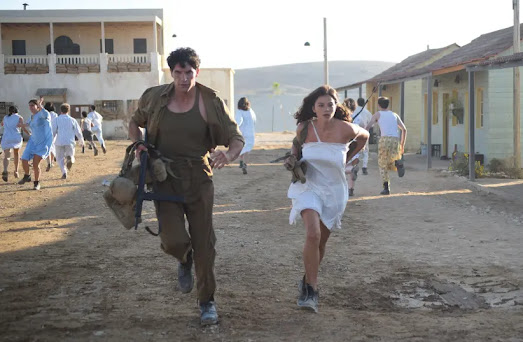


Overall, I feel that it was a good film but not a great one. Many of the characters were lacking in depth, and the script was often childish. Nevertheless, it was a moving and authentic re-enactment of an important part of the War of Independence, with a new twist. It was particularly fascinating to get a glimpse of how some Egyptians saw us during that war, as not much more than a bunch of colonizers who were settling on contested land. Bringing the Egyptian narrative into the film was an important innovation—it allowed us to see “the other side” for once in one of our wars, and help us get some insights into what they were thinking and feeling.

Without offering a spoiler, history has taught us that Israel lost the battle for Nitzanim, but Egypt never succeeded in its main goal of destroying Tel Aviv (and eliminating the state of Israel!) and therefore Egypt (and the other Arab countries) lost the war, even though they won this particular battle. Historians in Israel in recent years have revealed that even though the Arab armies were larger and better equipped (as we saw in this film), the young Israeli army was better organized, which was one of the main reasons that it was able to be victorious.

Avi Nesher is a highly acclaimed filmmaker and many of his films have been previously reviewed on this blog.  In his earlier period, in the 70s, he made Sing Your Heart Out (The Troupe) and Dizengoff 99.  After a long period of filmmaking in Hollywood, he returned to work in Israel and made Turn Left at the End of the World (2004), Secrets (2007), Matchmaker (2010), Wonders (2013), Past Life (2016), The Other Story (2018).


Tuesday, February 1, 2022

Tantura, The Story of an Arab Village from 1948

Tantura, directed by Alon Schwarz, is a new meticulously-researched documentary film which tells a disturbing story from the 1948 war, including a shocking and senseless killing, and a massive cover-up in its wake.  The film includes interviews with perpetrators, victims and witnesses (many now more than 90 years old), recreations, and never-before-seen archival material from the 1948 war.

The Arab village of Tantura was located on the coast, a bit south of Haifa, near Zichron Ya’akov, where Kibbutz Nachsholim and Dor Beach are located today. The soldiers of the Alexandroni Brigade conquered the village in 1948, and the surviving villagers were expelled – some of them across the border.  There had always been rumors of a massacre there, and in the 1990s, Teddy Katz, a graduate student at Haifa University, interviewed more than 130 people – both Jews and Arabs – as primary research material for the writing of a Master’s thesis.  He stated in his thesis that not only were the Palestinians of Tantura expelled from their village, but there was also a massacre of perhaps as many as 200 unarmed men which took place after the conquest of the village was concluded. 

A conspiracy of silence had been created by the veterans of the Alexandroni Brigade.  At the time that Katz’s thesis became public through a report in an Israeli newspaper, members of the brigade’s veterans’ association sued Katz in civil court for libel, forcing him to deny his academic findings and to apologize saying that no massacre had taken place. 

Now, more than twenty years later, filmmaker Alon Schwarz provides the viewer with an enormous body of testimony – using the original audio recordings from Teddy Katz’s research, original documents and also contemporary interviews -- in order to build a story of what happened in that village so many years ago.

This film is part of the ongoing story of the Nakbah, the Arabic word for “catastrophe”, which refers to the terrible tragedy that befell the Palestinian people during the 1948 war, in which hundreds of Palestinian villages were destroyed.  In some cases, the villagers fled, but in many other cases Palestinians were expelled or forced to flee by intimidation.  Later on, tractors were sent in to demolish the villages. As if this was not enough, there were also terrible atrocities that occurred – senseless killing of unarmed villagers, looting, and cases of rape. 

But Israelis like to think of themselves as the under-dog in this war. Also, atrocities were committed not only by Jews but also by Palestinians in that very difficult war. Nevertheless, an entire myth of denial of the Nakbah has been built up in Israeli society which includes the refusal to teach about it in Israeli schools and the claim that the Israeli army is the most moral army in the world.  During wartime, however, armies by definition do many immoral things.  Apparently, the Israeli army in the 1948 war was not immune to such acts.

Many questions remained in my mind after viewing this difficult film: can Israeli society acknowledge the destruction of the village of Tantura, the massacre, the expulsion and the ensuing years of denial? Will grappling with the terrible atrocities committed during the 1948 war help us to move on?  Will it help the descendants of Tantura come to terms with what happened there?  As journalist Gideon Levy wrote last week in Ha’aretz, won’t this help to lay the ghosts of the past to rest?  Perhaps this film could be the first step along the path of mutual recognition of past sins, similar to the Truth and Reconciliation commission of South Africa.

The film Tantura (documentary, 90 minutes) was produced with funding from two Israeli mainstream bodies: HOT cable TV and the New Fund for Cinema and TV.  The film is available from Reel Peak Films. 


Monday, July 24, 2017

The Lingering Trauma of Deir Yessin

Born in Deir Yessin, directed by Neta Shoshani, is a new documentary film that premiered at the Jerusalem Film Festival last week.  This stark and disturbing film tells the Israeli version of a dark stain on Israeli history of the War of Independence -- the story of Deir Yessin, the Arab village on the outskirts of Jerusalem that was conquered by the Lehi and Irgun, and the ensuing massacre that took place there.

Now, years later, we hear from the Lehi and Irgun perpetrators, the Haganah intelligence operatives who were sent to check out what actually transpired, and the Jerusalem teenagers who were sent to bury the corpses.  The stories include how grenades were thrown into houses and entire families were killed, and how people were lined up and shot against the wall.

The filmmaker pushes the perpetrators to remember the past.  They talk about their memories and their rationalizations. One says: “We fought so that the next generation would take the state for granted.” And another one states: “It was a dirty job but it achieved an important objective.” 
Some of the veterans of these Jewish extremist groups who were interviewed are portrayed by the director of the film as stark raving lunatics. This is a veiled reference to similar extremists in today's Israel who commit unspeakable deeds.

During the early 1950s, the abandoned village of Deir Yassin was closed off to the public and the Givat Shaul psychiatric hospital was built on the ruins.  In a fascinating way, a parallel story is offered in the film.  In the 1960s, a Jewish boy named Dror was born in the hospital, and sent away to be brought up apart from his mother, who spent most of her life in the asylum. Today, he returns to request his mother’s medical records and he reads about the traumas and the suffering of a woman whose baby was taken from her.

The metaphor is quite clear – we are all victims of our past and Deir Yassin represents a stain on our history, a part of our past which is kept closed away in the archives.  We cannot escape who we are and what elements from our past have influenced us.  And some of us have become completely insane from the ongoing cycle of violence which continues to haunt us. In some eerie way, the filmmaker is suggesting to us that we all live in an insane existence on the ruins of this village!

This is a particularly stirring and well-presented documentary film about one side of the story.  It does not try to tell the Palestinian narrative about the suffering, the individuals who were killed, the women and the children or the wild exaggerations that were used in the Arab world to inflate the size of the massacre, causing many Palestinians to flee their homes.  Rather it focuses on the ongoing Israeli struggle to come to grips with such a tragic part of our past.


Born in Deir Yessin (documentary, 63 minutes) can be obtained from Rotem.faran@gmail.com

Thursday, August 13, 2015

Moral Dilemmas


Last night I went to see Tubianski, an historical drama by Riki Shelach. Shelach works mostly as a film producer.  He directed the feature film, The Last Winter, 1982, which I very much liked. 

This is a fascinating drama about a slice of history from the period of the War of Independence in 1948.  Notwithstanding the fact that very little context is provided and the characters are not fully developed, the film offers a window into a certain period, the pressures on a society under siege, and the new Israel Defense Forces in-the-making.  In addition, the film reflects some of the dilemmas and moral issues that faced the nation at that time.

The story revolves around an officer in the IDF, Meir Tubianski, who is seen as a bit of an outsider.  Having served in the British army, he wants to do everything by the book, which is not so easy in the newly developing military framework.  In addition to being in charge of the Jerusalem airport, his civilian responsibilities include working at the Electric Company.  A jealous fellow worker goes to the Jerusalem intelligence branch of the army to accuse him of espionage and the story unfolds as Captain Tubianski is accused of betraying his country in a hastily convened military kangaroo court. 

Based on a true story from 1948, Captain Tubianski's wife wrote to Prime Minister David Ben Gurion himself, who, a year later,  had him fully exonerated and buried in a military burial on Mt. Herzl.  

You might want to check out my husband's post on TheTimes of Israel to get a more fully developed look at the context. 


Tubianski is a feature film,  75 minutes, produced by United King and Reshet TV.

Tuesday, March 19, 2013

Mixing the Personal and the National


Israel: A Home Movie (Eliav Lilti and Arik Bernstein)כך ראינו  is a stirring documentary that uses home movie footage collected from attics and storage spaces. The filmmakers have created a mosaic that is the history of Israel from the 1920s until the end of the 1970s, a mosaic that combines the personal and the national.  The family scenes and scenes of everyday life are interspersed with footage of national events and footage of people on the move -- survivors arriving, evacuating children during the War of Independence, Arab refugees during the period of the establishment of the State, and new immigrants arriving from Yemen. 

Not only is the footage unique and rare, but the soundtrack is not your typical narration.  It is made-up of people telling their stories, commenting as their footage is shown -- here is my father, here you can see me 50 years ago, this is my uncle going off to war -- singing songs and relating personal memories, commenting about those days filled with nostalgia, about people who are no longer with us, and asking how things might have been different. 

I found the section of the film during the period prior to and following the Six Day War to be the most compelling.  We see Divided Jerusalem and shots of the Old City before the city is reunited.  Following the war, a special event is documented when eight couples get married at the Cave of the Machpelah.   We see Udi Dayan filming photos of his iconic father which he found all over the Arab market after the War. 

Perhaps not surprisingly, there is a tremendous amount of footage of wars -- tanks, downing of planes, battlefields, military parades and the not-so-humane treatment of POWs.  The film concludes with the victory of the Likud in 1977 and the visit of Anwar Sadat. 

It seems to be a common downfall of documentary filmmakers that they are unable to part with their footage!  Perhaps this film is also a bit too long (100 minutes)!  I would recommend watching it in two sittings!

Israel: A Home Movie (100 minutes, 2012, documentary) is available from Go2Films